Traditionalist Issues
 |
 |
 |
 |
 |
 |
 |
Dialogue Mass - CLXVI
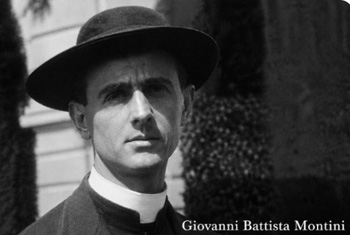
Don Giovanni Battista Montini
Ordained in 1920 in the diocese of Brescia, the young Don Battista, as he was called before becoming Archbishop, Cardinal and Pope, was profoundly influenced by Don Sturzo’s Popular Party, whose members (the Popolari), representing the Christian Democrats, were on the left of the political spectrum. His family lived and breathed Italian politics1 to the extent that, for them, Catholicism and anti-government revolution were synonymous. As one biographer remarked:
 “Born to this family of Brescian Popolari who so firmly believed in the social and political nature of Catholicism, Giovanni Battista Montini developed a keen sense of Christianity’s reforming nature. He never questioned the propriety of mixing religion and politics. For Montini, there could be no other way; it was the duty of Catholics to transform society and to make the social precepts of the Gospel, as Utopian as they might seem, a reality.” 2
But this is exactly the crux of the problem with officially-approved Catholic Action, then and now. There is a world of difference between wanting to remake society according to “Social Justice” principles and helping the poor through evangelical charity. The Faith and legacy of the Saints who transformed society and helped the poor are qualitatively different from the kind of politics pursued by the priests of the Liturgical Movement who dedicated their lives to it. They represent only the tip of an enormous iceberg extending to our day. The so-called “social precepts of the Gospel” were anything but Utopian; nor were they imbued with the subversive meaning attributed to them by neo-Modernist, Marxist-inspired priests.
 Here, we may pause to interject a pertinent point that Pope Leo XIV, in imitation of his conciliar predecessors, especially Francis, is still playing the “Social Justice” card and perpetuating the false equivalence between religion and politics, in which anti-Capitalism is, outrageously, seen as the path to holiness.
This theme was presented in Leo XIV’s first formal document of his pontificate, the Apostolic Exhortation, Dilexi Te, of October 4, 2025, in which he exploited the Feast of St. Francis of Assisi to preach ad nauseam a political message of barely disguised anti-Capitalism. In August 2026, he addressed a delegation of the St. Vincent de Paul Society from the United States where he misattributed to the French Saint the teaching that prayer and action on behalf of social justice are complementary and inseparable.” 3
Revenons à nos moutons. During his tenure as National Chaplain of the Italian Catholic University Federation (FUCI), a post Montini held from 1925-1933, he was known for his attempts to reconcile Socialism with Christianity. This ideology was further developed in his 1967 Encyclical, Populorum Progressio, a quasi-political manifesto, in which he gave major emphasis to his pipe dream of a global economy which would supplant Capitalism and supposedly end world poverty.
His theory about a point of convergence between Socialism and Christianity had already been shown to be a fantasy by Pius XI, who definitely settled any doubts in this matter by solemnly declaring that Socialism, even in its more moderate form, is irreconcilable with the teachings of Christianity.
 When he was the spiritual director of the fucini (the university student members of the FUCI), Montini was in a prime position to spread the influence of his ideas on a national and international scale. He gave lectures and retreats for the students, organized conferences and national congresses, accompanied them in social and political action, and co-founded the review,
Studium, of which he became the editor and main contributor.4 From his articles, we can glean some of the ideas that he inculcated into the rising generation of Catholic intellectual and political leaders of Europe. These reveal the core thinking of Montini the
fucini:
When he was the spiritual director of the fucini (the university student members of the FUCI), Montini was in a prime position to spread the influence of his ideas on a national and international scale. He gave lectures and retreats for the students, organized conferences and national congresses, accompanied them in social and political action, and co-founded the review,
Studium, of which he became the editor and main contributor.4 From his articles, we can glean some of the ideas that he inculcated into the rising generation of Catholic intellectual and political leaders of Europe. These reveal the core thinking of Montini the
fucini:
An important conclusion logically arises, relevant to current demands for obedience to the Magisterium of Vatican II as the litmus test for who is in full communion with the Catholic Church. No one can be constrained to accept any of the above novel teachings as proof of Catholic identity, considering their origin in the divided mind of a worldly-minded Pope who gained the position to ensure that the Council he presided over would fulfill the utopian fantasies of his youth.
The outcome of his deviations from the Petrine office was a new Mass for a new religion (to reconcile the Church with the modern world), neither of which can be described as genuinely Catholic.
To be continued

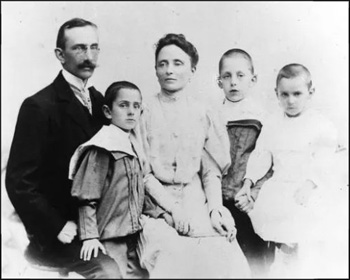
Giovanni Battista Montini as a child, first at right
But this is exactly the crux of the problem with officially-approved Catholic Action, then and now. There is a world of difference between wanting to remake society according to “Social Justice” principles and helping the poor through evangelical charity. The Faith and legacy of the Saints who transformed society and helped the poor are qualitatively different from the kind of politics pursued by the priests of the Liturgical Movement who dedicated their lives to it. They represent only the tip of an enormous iceberg extending to our day. The so-called “social precepts of the Gospel” were anything but Utopian; nor were they imbued with the subversive meaning attributed to them by neo-Modernist, Marxist-inspired priests.
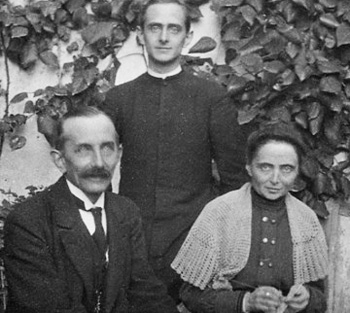
Montini with his parents as a seminarian
This theme was presented in Leo XIV’s first formal document of his pontificate, the Apostolic Exhortation, Dilexi Te, of October 4, 2025, in which he exploited the Feast of St. Francis of Assisi to preach ad nauseam a political message of barely disguised anti-Capitalism. In August 2026, he addressed a delegation of the St. Vincent de Paul Society from the United States where he misattributed to the French Saint the teaching that prayer and action on behalf of social justice are complementary and inseparable.” 3
Revenons à nos moutons. During his tenure as National Chaplain of the Italian Catholic University Federation (FUCI), a post Montini held from 1925-1933, he was known for his attempts to reconcile Socialism with Christianity. This ideology was further developed in his 1967 Encyclical, Populorum Progressio, a quasi-political manifesto, in which he gave major emphasis to his pipe dream of a global economy which would supplant Capitalism and supposedly end world poverty.
His theory about a point of convergence between Socialism and Christianity had already been shown to be a fantasy by Pius XI, who definitely settled any doubts in this matter by solemnly declaring that Socialism, even in its more moderate form, is irreconcilable with the teachings of Christianity.
Montini at the time he was spiritual director of FUCI
- The Federation should be open and willing to enter into dialogue with the modern world;
- It must not condemn the spirit of the world or criticize modern culture;
- It must shun traditional apologetics as “fanatical anti-Modernism”;
- Its attitude should be one of assimilation, not of a spirit of conquest;
- It should adopt a policy of religious liberty and the separation of Church and State;
- The laity should exercise active participation in the liturgy as of baptismal right because, on the Day of Pentecost, lay people participated directly in the mission of the Church without any mediation of the Hierarchy;
- All members of the Federation should engage in “Social Justice” activism to liberate the poor and the workers, and be prepared to adopt economic policies akin to Socialism.
An important conclusion logically arises, relevant to current demands for obedience to the Magisterium of Vatican II as the litmus test for who is in full communion with the Catholic Church. No one can be constrained to accept any of the above novel teachings as proof of Catholic identity, considering their origin in the divided mind of a worldly-minded Pope who gained the position to ensure that the Council he presided over would fulfill the utopian fantasies of his youth.
The outcome of his deviations from the Petrine office was a new Mass for a new religion (to reconcile the Church with the modern world), neither of which can be described as genuinely Catholic.
To be continued
- His father, Giorgio Montini, had been recommended by Benedict XV to be President of the Italian Electoral Union, a political party that prepared the ground for Don Sturzo’s Popular Party, and was a leading member of the Christian Democrats.
- Richard J. Wolff, ‘Giovanni Battista Montini and Italian Politics, 1897-1933: The Early Life of Pope Paul VI’. The Catholic Historical Review, vol. 71, n. 2, Catholic University Press of America, 1985, p. 247.
- Devin Watkins, ‘Pope Leo: Prayer and social justice are inseparable,’ Vatican News, August 26, 2026.
- A collection of these articles has been published under the title Coscienza universitaria: Note per gli studenti (The Conscience of a University: Notes for Students), Rome: Edizioni Studium, 1930.
Posted October 12, 2026


______________________
______________________
 Volume I |
 Volume II |
 Volume III |
 Volume IV |
 Volume V |
 Volume VI |
 Volume VII |
 Volume VIII |
 Volume IX |
 Volume X |
 Volume XI |
 Special Edition |