Traditionalist Issues
 |
 |
 |
 |
 |
 |
 |
Dialogue Mass - CLX
Heterodox & Subversive Characters of the Sillon
Another French priest, Fr. Emmanuel Barbier, was a redoubtable and tireless opponent of all forms of religious Modernism and Liberalism at the turn of the 20th century, as can be seen in his prolific publications. He was an eminently well-qualified priest who was more than capable of challenging the pretensions of Marc Sangnier on the theological battlefield and exposing the errors into which the Sillon fell under his leadership.
In this task, he was supported by, among others, the Bishops of Cambrai, Beauvais, Montpellier, Nancy and Quimper, who were openly critical of the Sillon for causing division among the faithful in their Dioceses.
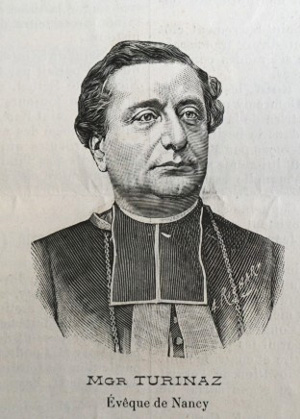
In a letter to Fr. Barbier, the Bishop of Nancy, Msgr. Charles-François Turinaz, showed how this came about. When the Sillon entered a diocese, he said, its members defied the orders of Leo XIII and Pius X as well as the authority of the local Bishop, and introduced division where none existed before, where charitable organizations flourished and peace reigned among the clergy and the people:
 “The Sillon creates divisions among the clergy, among the Catholic youth, among the faithful in the towns and countryside. It does so by rejecting all those who are unwilling to admire its ideas on the Republic and Democracy, and by treating them as the most dangerous enemies of the Church. It creates division between, on the one hand, the workers and, on the other, their employers whom they want to eliminate from the workforce; among the workers themselves by promoting the
'red' unions, that is, unions of the Revolution and Internationalism, and by criticizing the unions which uphold a harmonious relationship with employers.” 1
“The Sillon creates divisions among the clergy, among the Catholic youth, among the faithful in the towns and countryside. It does so by rejecting all those who are unwilling to admire its ideas on the Republic and Democracy, and by treating them as the most dangerous enemies of the Church. It creates division between, on the one hand, the workers and, on the other, their employers whom they want to eliminate from the workforce; among the workers themselves by promoting the
'red' unions, that is, unions of the Revolution and Internationalism, and by criticizing the unions which uphold a harmonious relationship with employers.” 1
It is obvious that the root problem is the creation of two parties and two loyalties requiring priests and faithful to take sides for or against the authority structures of the Church. St. Pius X famously said that Catholics should choose “the Party of God,” and Leo XIII taught that the social question is first and foremost a moral and, therefore, a religious question, and cannot be solved by means which are alien to Catholicism.
This brings us to Fr. Barbier’s exhaustive historical analysis of the Sillon, its nature, methods and aims. In his book, Les Erreurs du Sillon (The Errors of the Sillon), he provided a helpful summary (pp. 366-368) of the many points on which this organization failed the test of Catholic orthodoxy in its attempt to build the “future city” of Marc Sangnier’s dreams. The following points, each of which is meticulously researched and verified by documentary evidence, are the most relevant, and illustrate the Sillon’s transgressions in religious, political and social matters:
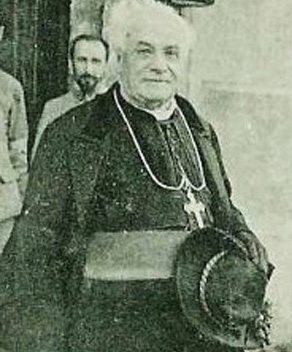 Another weighty testimony came from the Archbishop of Reims, Card. Louis Luçon who opposed attempts to set up a Sillonist circle in his Archdiocese.
In the December 1908 edition of the Bulletin du Diocèse de Reims, the Sillon was described as a “fléau” (a scourge) on the following grounds:
“With reference to the political and social organization called the Sillon, the most common result of its actions is easy to see: It is to sow division, to detach young people from Catholic works and draw them away from the influence of the clergy in social matters.
“The influence of the Sillon is abominable, and the state of mind it creates in its followers is dire: It causes even the best among them to lose the exact notion of truth and right judgment, and also a sense of respect.”
Continued

In this task, he was supported by, among others, the Bishops of Cambrai, Beauvais, Montpellier, Nancy and Quimper, who were openly critical of the Sillon for causing division among the faithful in their Dioceses.
In a letter to Fr. Barbier, the Bishop of Nancy, Msgr. Charles-François Turinaz, showed how this came about. When the Sillon entered a diocese, he said, its members defied the orders of Leo XIII and Pius X as well as the authority of the local Bishop, and introduced division where none existed before, where charitable organizations flourished and peace reigned among the clergy and the people:
Msgr. Charles-François Turinaz, Bishop of Nancy, a strong critic of the Sillon movement
It is obvious that the root problem is the creation of two parties and two loyalties requiring priests and faithful to take sides for or against the authority structures of the Church. St. Pius X famously said that Catholics should choose “the Party of God,” and Leo XIII taught that the social question is first and foremost a moral and, therefore, a religious question, and cannot be solved by means which are alien to Catholicism.
This brings us to Fr. Barbier’s exhaustive historical analysis of the Sillon, its nature, methods and aims. In his book, Les Erreurs du Sillon (The Errors of the Sillon), he provided a helpful summary (pp. 366-368) of the many points on which this organization failed the test of Catholic orthodoxy in its attempt to build the “future city” of Marc Sangnier’s dreams. The following points, each of which is meticulously researched and verified by documentary evidence, are the most relevant, and illustrate the Sillon’s transgressions in religious, political and social matters:
- It popularized, in France, the heresy of “Americanism” 2 – condemned in 1899 by Leo XIII – which valued action over contemplation, bypassed the teaching authority of the Church, and encouraged reliance on the individual conscience claiming direct inspiration by the Holy Spirit;
- It propagated false notions of dogma, especially the evolutionary ideas of Fr. Alfred Loisy that denied or diminished Catholic truths and principles in order to conciliate non-believers and adapt the Church to modern times;
- It called for a reform of ecclesiastical studies; it denigrated the authority of St. Thomas Aquinas, declared Scholasticism to be of no value, denied any necessary link between philosophy and theology, and replaced the rational proofs of God’s existence by inner feelings and experiences;
- It publicly condemned the idea of a State religion, condoned the separation of Church and State and enthusiastically endorsed the French government’s 1905 Law of Separation which divested France of its Catholic heritage and caused profound grief to St. Pius X; 3
- It opposed Patriotism, 4 using expressions suited to International Socialism and humanitarianism, and considered the military defence of one’s country as “immoral”;
5
- It disturbed the social order by participating in revolutionary acts contrary to the Natural Law and Catholic Morals, sowing division everywhere;
- It preached a mystique of humanitarian Socialism, confusing its republican democratic action with the social teaching of the Church, and used the Gospels to justify its doctrinal errors;
- It denounced ownership of property as incompatible with the Christian spirit, and reduced it to a minimum because it would be an obstacle to the construction of its touted “future city” based on collectivist principles;
- It preached the levelling of classes, roused covetousness and rancor among the workers against their employers, refused to seek a solution in a harmonious relationship between them, and wanted trade unions to exclude employers so that the workers could achieve their own emancipation and eliminate the bosses;
- It planned a radical reorganization of society on a socialist basis: all public utility services owned by capitalists should be expropriated by the State; ownership of smaller private enterprises and means of production – in industry, commerce and agriculture – should be placed in the hands of the workers;
- This was Sangnier’s programme of reform which he stated in an address that he delivered at a Sillon Conference in July 1908, when questioned by a representative of the militant Left-wing Trade Union, the Confédération Générale du Travail which fought for social ownership and workers’ control.
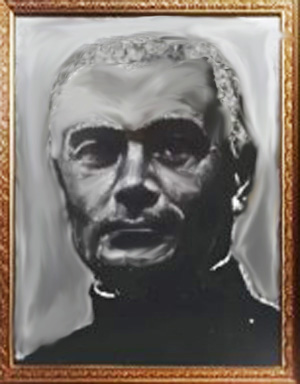
Fr. Emmanuel Barbier; below, his book on the errors of the Sillon

Card. Louis Luçon: ‘The Sillon is a scourge’
In the December 1908 edition of the Bulletin du Diocèse de Reims, the Sillon was described as a “fléau” (a scourge) on the following grounds:
“With reference to the political and social organization called the Sillon, the most common result of its actions is easy to see: It is to sow division, to detach young people from Catholic works and draw them away from the influence of the clergy in social matters.
“The influence of the Sillon is abominable, and the state of mind it creates in its followers is dire: It causes even the best among them to lose the exact notion of truth and right judgment, and also a sense of respect.”
Continued
- Emmanuel Barbier, Les Erreurs du Sillon: Histoire Documentaire (The Errors of the Sillon: A Documentary History), Paris: Lethielleux, 1906, p. 10.
- Before being named and condemned by St. Pius X in the Encyclical Pascendi Dominici gregis, Modernism was known as Americanism, due its initial experiences in the United States. Both have the same inspiration and the same errors.
- St. Pius X condemned this principle in Vehementer nos (1906): “that the State must be separated from the Church is a thesis absolutely false, a most pernicious error.”
- According to Catholic teaching, to reject Patriotism, which is part of the virtue of piety, is a violation of the Fourth Commandment and a failure in charity and justice towards one’s own country. Addressing Republicans and Socialists at a public meeting, Sangnier stated: “We love France passionately, but we regard it as the terrain of the use of all humanity, and we are in some sense internationalist patriots.” Ibid., p. 119.
- Sangnier’s position was refuted by Msgr. Turinaz, Bishop of Nancy, who spoke extensively on the virtue of Patriotism and cited the example of Joan of Arc as “the embodiment of the purest and most heroic patriotism.” (Charles-François Turinaz, Discours Patriotiques (Patriotic Speeches), Paris: Roger & Chernoviz, 1901, p. 102.
- Sangnier’s speech was reported by Msgr. Théodore Delmont in Modernisme et Modernistes en Italie en Allemagne, en Angleterre et en France (Modernism and Modernists in Italy, Germany, England and France), Paris: Lethielleux, 1909, p. 446.
- Ibid., p. 447.
Posted April 10, 2026


______________________
______________________
 Volume I |
 Volume II |
 Volume III |
 Volume IV |
 Volume V |
 Volume VI |
 Volume VII |
 Volume VIII |
 Volume IX |
 Volume X |
 Volume XI |
 Special Edition |