Theology of History
 |
 |
 |
 |
 |
 |
 |
Egalitarianism - XVI
The Angelic & Human Hierarchies of Power
Note: Prof. Plinio gave this series of classes in 1957; today in 2026 we see how the egalitarianism in each of the fields he pointed out has increased and come to dominate almost completely. TIAIs this organization of the angelic realm – structured as we saw here and here – also reflected in some way among men on Earth? What is the nature of the inequality among men on Earth?
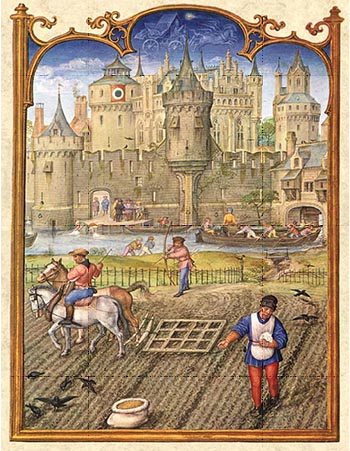
Who should rule in the castle &
who should plow the fields?
What are the cognitive faculties that determine a man's right to command? To grasp this fully, we must understand what is meant by "cognitive faculties" and how the whole system functions.
If we analyze the schema of the Angels and imagine it applied to Earth, we might think that we are justifying a theocracy – where the most intelligent men, those with greater cognitive capacity, should have the power, while the less intelligent, those with lesser cognitive capacity, should obey. Thus we would have a paradise for technocrats and, to a certain extent, a paradise for university professors.
Who should command?
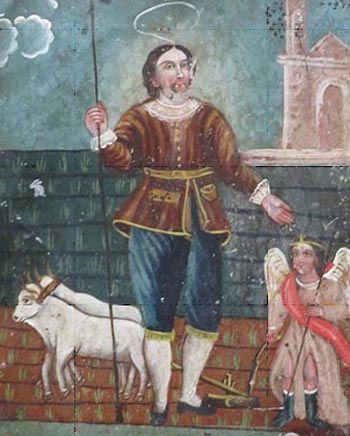
Should St. Isidore the farmer rule the city
only because he is holy?
There is another formulation of this that comes in the perspective of virtue. Angels are not merely the wisest – that is, the most intelligent – but also the best. Many persons view life as a chaotic carnival because it is not governed by the most virtuous men – virtuous in the sense of being the most pious and holy.
Let us imagine a specific scenario: Someone comes along and says, "What an injustice! I know a man who is poor, simple and modest who is far better than so-and-so. He is the one who should be in charge. After all, it is not the wisest who should rule, but the best men."
This would be a schema to explain social inequalities, justifying them solely on the basis of talent or virtue.
How the Angels know the order of Providence
Let us turn to the illuminating knowledge possessed by the higher Angels by which they understand the profound order of Providence. What are we to make of it?
St. Thomas Aquinas addresses the matter. He asserts that the true hierarchy of beings is determined by their cognitive capacity; consequently, the greater an Angel's cognitive capacity, the higher its rank. The Seraphim contemplate God Himself, beholding Him directly as the ultimate end of creation. This is the most elevated form of contemplation that exists.
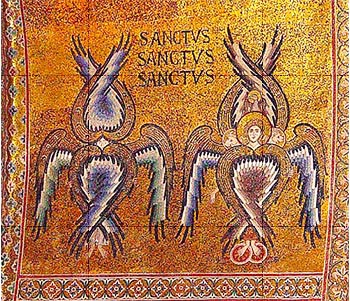
Seraphim are fiery spirits who circle the throne of God
The Cherubim do not have knowledge of the order of God's Providence directly; rather, they see it through the image God has of the universe He willed to create. In creating the universe, God creates an image of Himself, and it is this image that the Cherubim behold. It is a less direct form of knowledge.
Because of this, they have an imprecise notion of the ultimate end. They have a better notion of the means to achieve that end. Thus, their view of the details is much more limited. The Thrones, although they act to affect the universe, are something lesser and thus their vision of the details is also more limited.
St. Thomas states that the further down this process goes, the ideas of intellectual beings regarding the general end become more confused, and thus they also have a more vague and imprecise notion of the details
How man knows the order of Providence
This progression continues until it reaches man. At that point, the human soul possesses such a general and vague idea of the order of Providence that such notions do not suffice to understand it. Instead, one must observe and know individual beings in order to study the order of Providence.
Thus, he affirms, the human soul requires a body to know individual beings and, by analyzing them, to understand the order of Providence. So then, the body should not be a hindrance to the soul, but rather a means through which the soul comes to know reality. It is essential for the soul to understand the order of Providence.
At times we have the impression that after death the soul – freed from the body – will become much more intelligent. However, a soul separated from the body finds itself in a state of violence, for the body is the natural complement that enables man to know things. Therefore, man needs to know things through his body.
Man & animals
St. Thomas asserts, therefore, that among humans, true hierarchy is based on the fact that those with greater cognitive capacity command those with lesser. Next, comes man's dominion over animals, because the latter possess a cognitive capacity that cannot be called full consciousness.
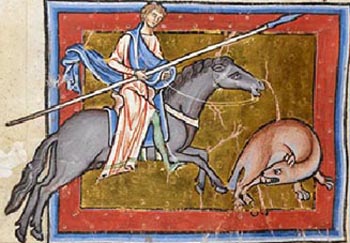
Man is called to dominate the animals:
A mounted hunter chasing a beaver
In any case, man dominates the animal. The animal, in turn, dominates the plants and the other beings that lack cognitive capacity. Thus, the hierarchy that exists in the universe is one based on cognitive capacities.
Among the beings lacking cognitive capacity, the hierarchy is based on operational capacity. For this reason, the hierarchy is more rigid among the beings that do not possess cognitive capacity. St. Thomas thus demonstrates the hierarchy of the universe in terms of cognitive capacity, showing that the same principle should apply among men.
How to resolve error when the stronger rule
Yet, as St. Thomas notes, we often see the strongest men assume the leadership while ignoring or disregarding those who are less strong. How is the dominion of the cognitive capacity achieved among men in such cases?
He affirms that the resulting disorder is not profound and, in that sense, not enduring. This is because when a man with low cognitive ability enters a difficult situation, the entanglements usually become so great that either he relies on men with good cognitive ability, or it falls to nature itself to correct its own deficiency and the man ends badly. Naturally, there are situations where this does not happen or that need to be analyzed in the long term. But undoubtedly there is much truth in this.
On the other hand, one can also note that today we live in a time of the deification of numbers, machines, etc. How can one maintain that this era is dominated by men of great cognitive capacity? The answer is that these mass ideas were supported by men of great cognitive ability. If all the educated and intelligent men were to oppose this, this situation could not persist.
Measuring the cognitive capacity of a man
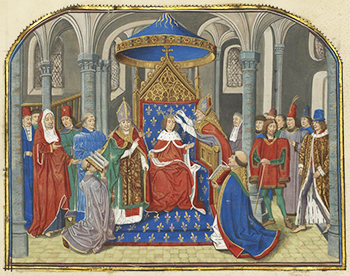
On what base did Pepin establish a new dynasty?
There cannot be a classification of intelligences that allows us to know which is the most intelligent to whom power should be delegated. We see that the exercise of power in this world does not properly fit into cognitive categories, but rather primarily into operational categories.
How, then, does this criterion that commands exercise its authority?
The answer is found in wisdom, which we look at in the next article.
Continued
Posted July 13-, 2026



______________________
______________________
 |
 |
 |