Theology of History
 |
 |
 |
 |
 |
 |
 |
Egalitarianism - VII
The Justification of Inequality
according to St. Thomas
Note: Prof. Plinio gave this series of classes in 1957; today in 2026 we see how the egalitarianism in each of the fields he points out has increased and come to dominate almost completely. TIAIn our last articles (here and here) we noted how we are facing a well-planned egalitarian Revolution that aims to transform everything in the universe that is transformable, in order to establish equality in all things.
Further, it aims to present various aspects of the universe that are not transformable by human action in such a way that man loses awareness of the inequalities that exist, and has the illusion of seeing equality in everything and everywhere.
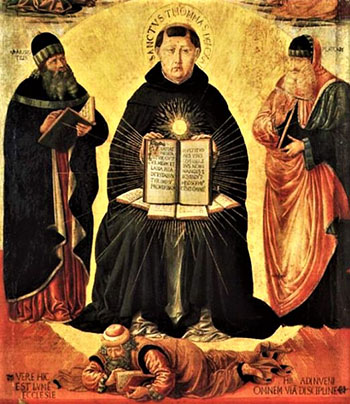
Glorification of the Summa contra Gentiles, based on Natural Law, triumphing over pagans
I had the opportunity to show that if mankind today aims at equality in all points and wants all things to be equal, in final analysis it considers equality as a supreme value. And it is equality that it loves more than anything and above all things. Then, we can say that today’s man has a real adoration for equality and has adopted the true myth of equality; in effect, man lives for equality.
Egalitarianism in the eyes of Religion
Thus we can legitimately ask: What is this equality in the eyes of Religion?
The revolutionary thesis is this: In all things, the greatest good to be attained is for each man to be equal to everyone else, and for each thing to be equal to everything else.
Departing from this revolutionary thesis, we must ask what the Church thinks.
In this analysis I will first state the thesis of St. Thomas, and then demonstrate that this is what the Catholic Church thinks.
Inequality is a good; to hate it is to oppose God
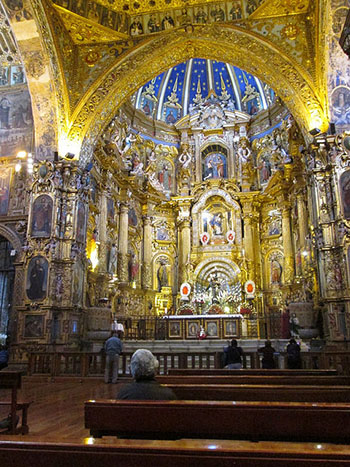
What marks the churches of the past is their sense of sacral inequality between man to God, above altar of Quito’s La Compañía de Jesús Church.
What marks the modern churches is their sense of equality between man with God.

In making the universe, God created it unequal so that the likeness of God might be better manifested in this way. The universe achieves its best expressions of God's likeness precisely through inequality.
To hate inequality is, therefore, to hate that which is most similar to God in the universe. To hate the likeness of God is to hate God Himself. Therefore, to desire equality as a supreme value is to desire the opposite of God.
Explanation of the proof
I decided to first state this thesis in another way so that there would be no doubt about it.
First, the Church affirms that God created the universe with inequalities, enormous inequalities. He is the author of these inequalities.
The second thesis of the Church is that these inequalities do not exist as a consequence of original sin, or as a punishment or any type of disfigurement introduced into the universe by evil and sin. On the contrary, inequality exists as an excellent quality of the universe, as a refinement of the universe’s perfection.
The third point is the reason why inequality is a perfection of the universe. This is demonstrated in the proofs that St. Thomas Aquinas gives, especially in his Summa contra Gentiles (Book II, chap. 45). It is through inequality that God best manifests himself to men. It is exactly because inequality exists in the universe that the resemblance of the universe to God shines more brightly in the eyes of men. For this reason, inequality represents a good in itself. It is because it provides the best resemblance of God.
For this reason, we come to the conclusion that wanting to destroy inequality in the universe is wanting to destroy what it has of the highest, the most excellent and the most God-like, so to speak, in which the aspect of God is best reflected.
Now, to hate that which most reflects God is to hate God Himself. Thus, it is an entirely evident thing that the Equalitarian Revolution is against God.
To hate what is similar to God is to hate God
Suppose that I were to decorate a room, write an article, or form the mind of a young man. Someone, seeing this room, says: "It is unpleasant." Reading the article, he says: "The article is disagreeable." Seeing the young man, he thinks: "I abhor this youth."

Inequality in nature makes God shine
more brightly in the eyes of men
Then, inequality is the best way to reflect the image of God. Therefore, to hate inequality is to hate God.
An argument based on St. Thomas
To understand the mechanics of this demonstration, I must remind the reader that we find many passages regarding the issue of equality and inequality scattered throughout the papal documents. Leo XIII has excellent passages on this, as does St. Pius X and several other Popes. It would be necessary to compile a collection of these pontifical texts on inequality in order to demonstrate that inequality is in accordance with Catholic doctrine and that equality is not something that should be sought.
Unfortunately, we have not yet had the patient and immensely efficient researcher to collect all these texts for us. Therefore, my demonstration here is based entirely on St. Thomas Aquinas, which is still of great value because we know that the Church recomnends Catholics to adopt the philosophy of St.Thomas.
Indeed, according to the Encyclical Aeterni Patris of Leo XIII (August 8, 1879), a Catholic must be a Thomist. And there is so much impressive evidence of the Church's support for St. Thomas Aquinas that it is worth offering some of this data here to understand its value from the point of view of Catholic doctrine.
The importance of St. Thomas Aquinas
Speaking to this audience, I know it is superfluous to affirm the importance of St. Thomas Aquinas. But, unfortunately, there are many Catholics who do not see St. Thomas with our eyes and who discuss his teaching as something completely debatable. So, since we will be confronting such Catholics, I think it is interesting to provide some information here so we can justify our position should any objectors pretend that we are basing ourselves on a Doctor whose opinion is respectable, but as susceptible to being challenged as that of anyone else.
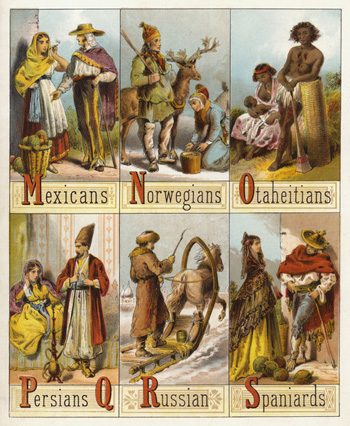
The different peoples also reflect the diversity & immensity of God
Second, the Encyclical Studiorum ducem of Pius XI (June 29, 1923) on St. Thomas Aquinas, recalls that at the Council of Trent, one of the greatest Councils of all time that took place in the 16th century to refute Protestant errors – there were only two works on the altar of the Council, where the books for consultation by the Council Fathers were kept: They were the Bible and the Summa Theologiae. Now, for a Council to place this work next to the Bible on an altar as a source of consultation, as a source of the infallible teaching of the Church, is certainly very significant.
Third, the Code of Canon Law, compiled by St. Pius X and promulgated by Benedict XV – that is, with the authority of the Pope – recommends that the official teaching in seminaries should be in accordance with the method and doctrine of St. Thomas Aquinas. This is, then, the orientation that the Church prescribes for the formation of her clergy.
Fourth, he has the authority (which many Saints also have) of a Doctor of the Church, and was elevated to this category in 1567 by another Saint, Pope St. Pius V.
Fifth, he has received the high praise of Popes. For example, John XXII (14th century) declared: "His doctrine in itself is miraculous because it exceeds the capacity of man to be as accurate as he was." "He alone enlightened the Church more than all the other Doctors together."
In Leo XIII's Encyclical Aeternis Patris, the Pope declares this about him: "He is like the sun because he heated the world with the warmth of his virtues and filled it with the splendor of his teaching."
In the rules of St. Ignatius of Loyola Sentire cum Ecclesia, the founder of the Company of Jesus points to following Scholastic Philosophy as a sign of a Catholic. That is, St. Thomas is such a Doctor that to follow him is a sign of a Catholic spirit; disagreeing with him is, therefore, a lack of the Catholic spirit. This is said by the greatest figure of the Catholic spirit, such as St. Ignatius, who shone in the matter of Catholic sense just as St. Teresa shone in the matter of prayer, etc.
Pius XII gave him the title "the Common Doctor of the whole Church," that is, Doctor of everyone for everything.
Finally, in the work of Pius XII, the references to St. Thomas Aquinas are countless.
Therefore, he is an incontestable authority.
With this established, we will move on to the actual Thomistic argument in the next article.
Continued
Posted January 21, 2026



______________________
______________________
 |
 |
 |