Theology of History
 |
 |
 |
 |
 |
 |
 |
Egalitarianism - IX
The Universe Must Glorify God
Note: Prof. Plinio gave this series of classes in 1957; today in 2026 we see how the egalitarianism in each of the fields he points out has increased and come to dominate almost completely. TIAIn the last article we saw the arguments against inequality. However, after giving these, St. Thomas goes on to demonstrate that inequality is a great good. The essence of his argument is the inequality reflects the glory of God, which in its turn reflects the perfections of God better than equality.
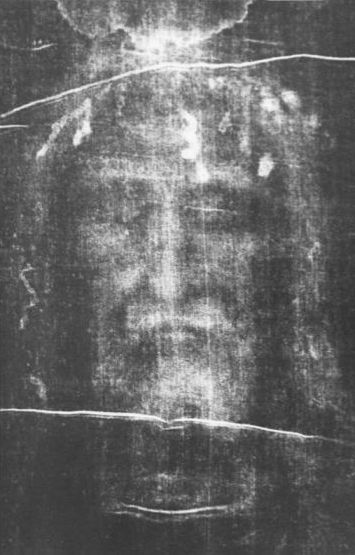
The Shroud of Turin reflects the intrinsic glory of Christ
Reflecting God's perfections
First, let us see more clearly what it is to reflect the perfections of God.
What exactly is glory? I have not yet found any definition of this word that completely satisfies me, although it can be said that glory is the splendor of someone's supreme qualities in themselves. It can be said that glory has two aspects: intrinsic glory and extrinsic glory.
A characteristic example of intrinsic glory that we have on this earth is Our Lord Jesus Christ. Whoever contemplates the Holy Shroud of Turin and contemplates the Face of Our Lord perceives there a majesty that is in Him and that comes from Himself; further, all the insults, pettiness, beatings and spittle could not diminish His intrinsic glory.
What his countenance shows is a great affirmation of an infinite superiority, which is immanent in Him and absolutely does not depend on anything or anyone. He is superior; others either see it or not, although it is transparent. His glory is intrinsic.
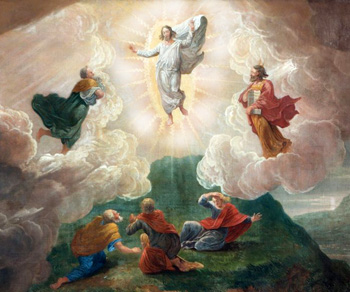
The Transfiguration of Christ on Mount Tabor
Just as there is an extrinsic and intrinsic glory in Our Lord, there is an intrinsic glory in God, which is His infinite superiority.There is also an extrinsic glory in the fact that creatures give glory to Him. It is a glory that comes from outside.
It is evident that God does not need extrinsic glory, intrinsic glory is sufficient for Him. But since creatures exist, they must give glory to Him. This is the raison d'être of creatures. Why is this the reason for being of creatures?
St. Thomas duly demonstrates that God, in creating the universe, could only create it out of love for Himself, and that the end of His action could only be Himself. And the reason of being of all creatures is His glory. Therefore, our reason for being is the glory of God.
Why does our likeness to God give glory to God? It is because the better a work is, the more it gives glory to the one who made it. For example, someone makes a watch. The better the watch, the greater the watchmaker. Now, then, God is perfection itself. If creatures desire to be very good, they must necessarily imitate God. He is the Author of all perfections, He is perfection itself, and everything that is very good must imitate God. Therefore, all creatures, in order to give glory to God by being very good, must imitate Him.
Summary of the argument
The argument, therefore, is this: Glory is only given to God through excellence; one can only be excellent by imitating God. Therefore, we only glorify God by imitating Him. From man's point of view, this can also be seen in another way. We are all destined to save ourselves, to glorify God through our salvation. Now, all things that exist in the universe exist to aid in our salvation. Therefore, the more the things that surround us are like God, the more they will help us in our salvation. In any case, the likeness of the universe to God is a condition for glorifying God.
The example of the creation of the Angels
St. Thomas begins by analyzing the highest part of the universe, which is the Angels.
They are not only the highest part, but also the most numerous. According to commentators, when the number in Heaven is complete, it will be verified that there are many more Angels than men. The number of Angels is truly unfathomable. We are not only quantitatively far inferior to the Angels, but also qualitatively. The vast majority of rational beings created by God are angelic beings.
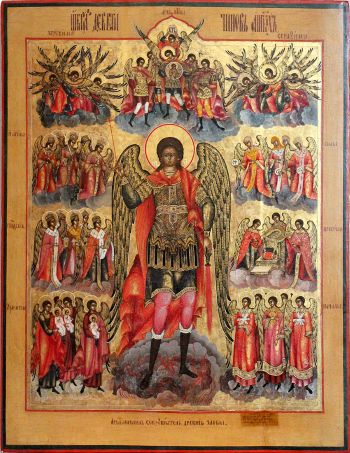
The Angels, each one superior to man, but nine choirs of different levels & purposes
When dealing with the Angels, St. Thomas Aquinas had relatively few texts in Revelation offering information about the Angels. He made a prodigious intellectual effort, using the data of natural wisdom, to arrive at a hypothesis about the Angels. And, having reached this hypothesis, he sought its confirmation in Revelation. Having obtained this confirmation, he affirmed that the angelic world is of a certain way. It was, in fact, a remarkable effort of intelligence. Some serious commentators on St. Thomas claims that the Treatise on Angels is one of St. Thomas's most distinguished treatises.
To fully understand the reasoning of St. Thomas, it is necessary to understand the problem he poses. The starting point is God Who hovers over all Creation, His Work, how He constituted a Creation that is an ordered cosmos and not a chaos. That is to say, He made a Creation in which the various parts are ordered in relation to each other, instead of being alien or heterogeneous to each other.
Further in His plan He established that He would govern some beings by means of other beings, so that the highest would receive the fullness of the light that He desired to communicate to creatures, and other beings would be governed by the highest, and so on, in various levels.
Then St. Thomas tries to show how this is done, which in truth constitutes a true theory of work. That is to say, he lays out the different stages of action, how many parts compose the action, and what each of these parts signifies. Then he shows how each of these parts corresponds to a category of Angels.
Therefore, we understand that in Heaven there is a true organization, an organization with rationalization and distribution, because there is true work taking place in Heaven. In the peace of Heaven, there is constant activity. This action of the Angels represents the most absolute, most intrinsic and most essential sense of the word action, with the word "action" indicating what the direction is and what its natural stages are. He then goes on to identify what the choirs of Angels are and how they relate to these natural stages of action.
All of this action evidently supposes a great inequality, which we will continue to study in the next article.
Continued
Posted March 2, 2026



______________________
______________________
 |
 |
 |