Theology of History
 |
 |
 |
 |
 |
 |
 |
Egalitarianism - XIII
How God Governs the Universe through
Intermediary Beings
Note: Prof. Plinio gave this series of classes in 1957; today in 2026 we see how the egalitarianism in each of the fields he points out has increased and come to dominate almost completely. TIAIn the last article, we considered the image of the unequal relationships established by God among the Angels and asked how it serves the glory of God since it was God Who established these inequalities. Several arguments were also presented that serve to justify inequality vs. egalitarianism in line with the thesis we have been developing.
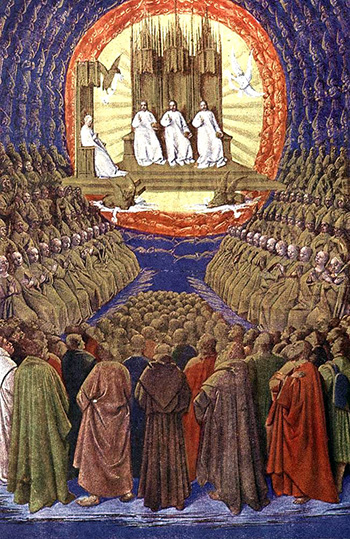
Heaven with its hierarchy & great inequalities
By presenting what is good in this hierarchy, we deduce, by exclusion, what is bad about egalitarianism. Thus have we arrived at the very heart of our problem.
God’s hierarchy in Creation
We must ask why God placed the Angels in such an unequal order and what is good about this inequality in Creation.
So, we can ask: Why does God not do everything directly? Why does he use beings inferior to Himself to govern the universe? ... The reasons follow.
1. It is not appropriate for the superior to undertake petty tasks
It is not befitting of God to execute the plan of His Providence to its final details, because the cognitive capacity is different from the operational capacity. The characteristic of the cognitive capacity is attention to the general; the characteristic of the operational capacity is to dwell on details.
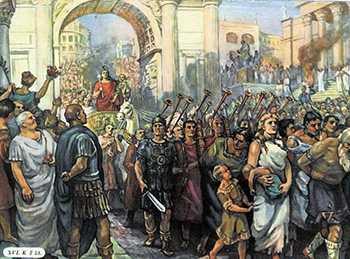
A Roman Triumph awarded to a victorious General, placed above the whole army
The Romans expressed this in two sentences: "The praetor is not concerned with trivialities," or, "The eagle does not catch flies." We cannot imagine God, in His infinite majesty, intervening directly to ensure that a specific animal species – for example, ants – does not become extinct. God uses intermediary beings to do such small things. What, then, does it fall to God to do? Those things that only He can do: resurrect, preserve in the being and give supernatural life. These things God does directly.
Herein lies the primary reason for this organization of the Angels. God establishes the intermediary governance of the universe through Angels and men. We shall see that animals and simpler beings are also instruments of God.
2. The 'step by step' action better expresses the greatness of God
The greatness of God is best expressed in ”step-by-step” action and through intermediate stages.
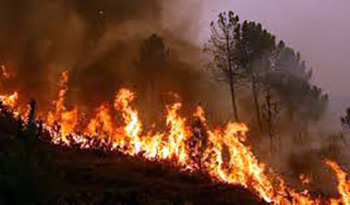
The more powerful the fire, the greater its reach
But, he says, every powerful action reaches its extremes by exercising itself over intermediaries. A flame, for example, does not heat the far ends of a room, but rather warms the layers of air immediately surrounding it; these layers warm others, and so on, until the heat reaches the far end of the room. Therefore, the action of "step by step” is the mode of action of very powerful causes.
Thus, he states, the action of God, which is supremely powerful, must also proceed “step by step,” acting upon some creatures through others.
After demonstrating why God uses some beings to act upon others, St. Thomas questions why God has so many agents to execute His will.
He answers: God has many intermediary agents because it is fitting for a great King to have many ministers. The great King should be served by many servants. Given that God is supremely powerful, He must have many servants. Hence, it is fitting to the greatness of God that the number of creatures be vast, and that the number of those who serve Him to govern the universe be also great.
3. God’s servants also govern their subjects
These many servants exercise their own government over subjects.
We see that God ordered the universe in such a way that it cannot simply be said that He has a great number of servants, butrather these servants, in turn, serve one another. They are not only direct servants of God, but also servants of one another. For example, the Cherubim serves the Seraphim, the Thrones serves the Cherubim, etc.

The sergeant is over his platoon, but he is under another higher officer in a whole chain of command
On the other hand, when, instead of having people who obey me directly, I have people who obey me who, in turn, command others, I, in relation to the one who obeys me, act as a cause, and the one who obeys me acts as an effect.
But he who obeys me commanding another acts in relation to the other as cause, and the one over whom he commands plays the role of effect. The general is the cause and the colonel is the effect. The action of the colonel is the effect of a cause, which is the general; but the action of the lieutenant colonel is the action of a cause, which is the colonel, and so on. As we descend in the hierarchy we find a relationship of reciprocal causes and effects.
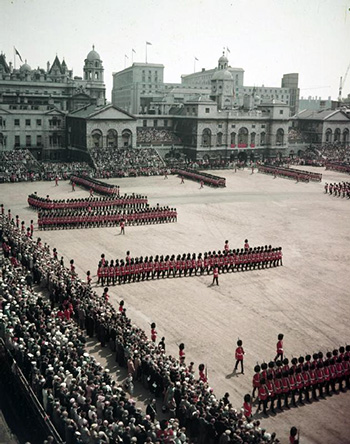
Britain's annual Trooping of the Colors parade, a magnificent display of the military order
Another example: In a university there is a beauty that resides in the autonomy of each professor. Imagine a university in which the Chancellor would dictate the teaching of all the professors, and each would simply repeat a specific lesson handed down to them by him. This would destroy the university, because it is the hierarchy of autonomous causes and effects that constitutes its beauty. Well, thist is the essence of Feudalism.
Herein lies the explanation why the Angelic Hierarchy was established for the greatness of God.
The first point explains why God does not do everything directly.
The second point explains why God has many ministers to maintain the order.
The third point is shows how and why these ministers are organized in a determined hierarchy.
It is intelligence in the natural order and the Catholic sense in the supernatural order that empower those who have power to command.

Continued
Posted May 25, 2026



______________________
______________________
 |
 |
 |