Catholic Customs
 |
 |
 |
 |
 |
 |
 |
The Feast of St. George the Dragon-Slayer
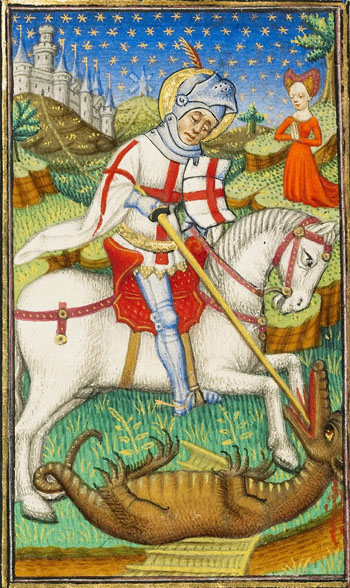
most brilliant luminary of earth – star of fairest light –
watchful guardian of such as honor thee!
be thou our guardian, O martyr George. (1)
The feast of the "holy and glorious great martyr" George was dear to the hearts of Catholic peoples of old. St. George was venerated as the patron of knights, horses, cattle, shepherds and farmers. His feast is commemorated on the date of his martyrdom: April 23, 304 A.D.
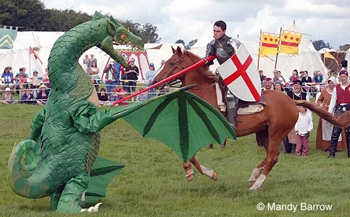
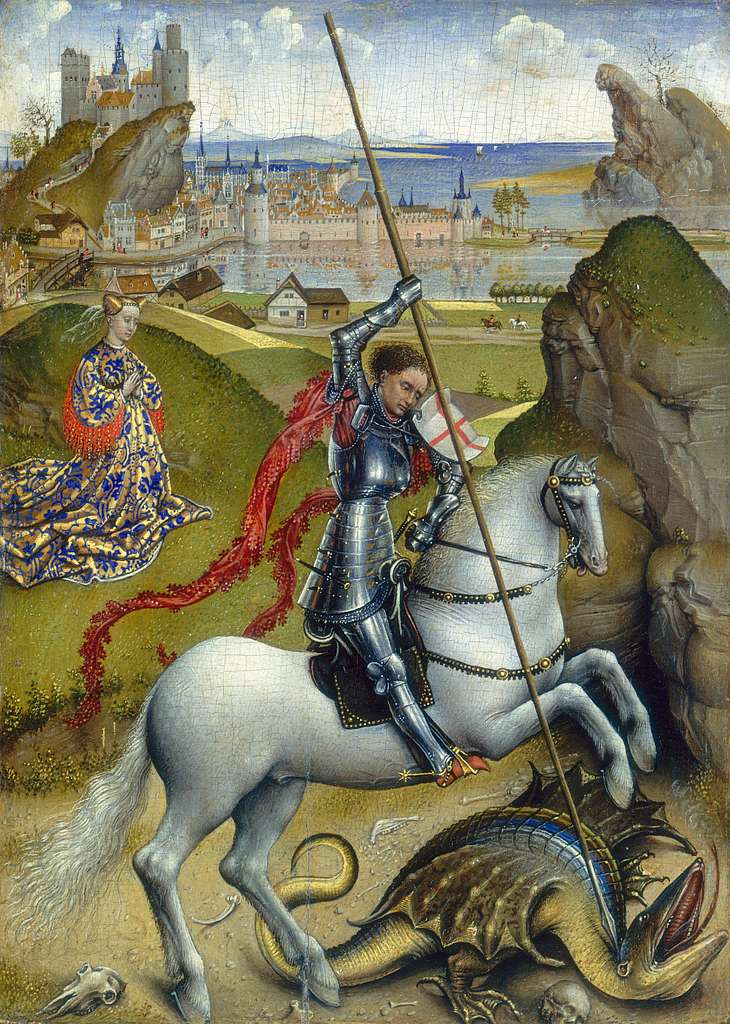
In the Middle Ages, peoples from many nations performed miracle plays of St. George slaying the dragon on his feast day. The performances were dramatic with grand costumes and elaborate props. When the dragon was slain, St. George's spear struck a bag filled with a red liquid that burst open to let "blood" flow from the body of the monster.
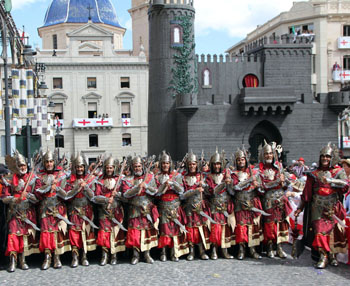
An army of 'Moors' outside the castle ready to attack the Christians; below, a recent reenactment of a medieval St. George play in England
In some parts of Greece, the people processed through the streets with an icon of St. George. In the village of Arachova, the old men followed the procession singing and dancing to the song of St. George. Before the song began, the village water supply was cut off. When the men arrived at the verse, “Dragon, set free the water that the revelers may drink,” the water supply was released. (3)
The people of southern Spain performed plays known as "Moros y Cristianos" that associated St. George with the reconquest of their country from the Moors. To this day in Alicante there are reenactments of the Battle of Alcoy (1276) when St George appeared to help defeat the Moorish forces lead by Al Azraq. On April 22, the grand parade of performers – some dressed as Christian Knights and others as Moors – winds through the streets marching to battle. The flag of St. George (a red cross on a white banner) hangs from every balcony.
The next day, the actual feast day, a solemn Mass is said followed by a procession with St. George’s relics and statue. On April 24, they reenact the battle. In the morning the Moors appear to be winning, but St. George appears and leads the Christians to victory. (4)
St. George brings the victory of Spring
St. George’s power over evil made him the perfect intercessor to drive demons and witches away from the homes and lands of the Catholic peasantry.
In the folklore of Western Europe, Spring began on May 1st and evil prowled about on its eve. However, in Eastern Europe, it was April 23, St. George’s Day that was regarded as the beginning of Spring, and as a transitional day between the season of darkness and the season of light ancient folklore held its eve to be a time when witches, demons and evil beasts were free to roam. (5) Hence the great need for St. George’s protection.
Perhaps, this is why the great Saint died on April 23. Divine Providence arranged this knowing that the pagans who entered the Church would better understand St. George’s vocation by a connection to the day on which cold and darkness had one of its last battles with warmth and light.

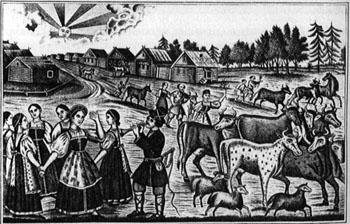
Blue harebells bloom in the fields as heralds of St. George’s Day; below, Russian peasants celebrate the return of Spring and the driving of the herds
According to Polish folklore, Our Lady gave St. George the privilege to live on the moon in recompense for his valorous deeds. On his feast day, St. George leaves the moon with a "key" that frees the earth from the chains of winter and allows plants and flowers to cover the land once again.
Many of these early spring plants became associated with St. George. In England, the blue Harebell was his flower, while elsewhere it was the Peony. In Syria and Asia Minor, the Carob was dedicated to St. George, whose shrines are always erected beneath its boughs. (7)
When St. George’s day arrived, the coming of Spring and joy to glorify the saint brought a great spirit of festivity. St. George was said to send the first dew down to the earth; thus, the early morning dew on his feast was believed to have medicinal powers. Russians and Bulgarians often walked barefoot in the dew, while Polish farmers mixed drops of dew with their animals' food. In some areas, their livestock were driven through the dew-covered fields. (8)
In Greece, athletic races and contests were held, followed by processions and dancing before the icon of St. George. One such race in the village of Arachova was “the race of the old men” in which the old men of the village raced barefooted up a steep slope. (9)
Under the Empire in Brazil, St. George became the patron of Rio de Janeiro. A great festival took place in the streets of the city with a procession of his statue that even the royalty joined on foot. Fireworks ended the gala day. (10)
In Medieval England, the feast of St. George was celebrated with great pomp. Guild members carried statues of St. George and the dragon in grand processions, and jousting tournaments and horse races took place.
The herds are driven to the fields
Because St. George was the guardian of cattle, sheep and goats, his feast was the preferred day to drive out the herds to the verdant spring pastures.
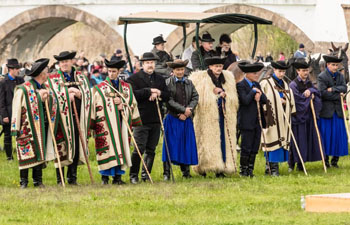
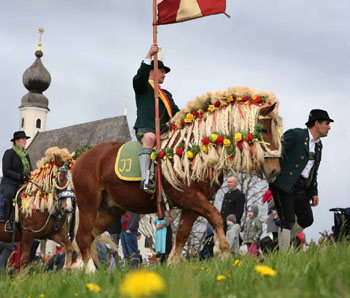
Hungarian Shepherds prepare to lead their flocks; below, A farmer of Traunstein proudly bears his banner
The herdsmen and shepherds donned their gayest apparel and the whole village came out to watch the joyous procession, listen to the jubilant notes of the shepherds’ horns, and say farewell to the shepherds. The herdsmen would spend all summer in the pastures and not return until sometime in September, usually on Michaelmas, which is most fitting since both St. Michael and St. George did battle with the Devil, the Ancient Dragon. (11)
In Greece and mountainous regions of Italy, farm contracts were signed on the feast of St. George, to be renewed on that day the next year. (12)
Greek shepherds invited relatives and friends to their sheepfolds on this day to celebrate together with a large meal featuring “the lamb of St. George” in thanksgiving to the Saint for benefits received through his intercession. (13)
Throughout Germany, Austria and Switzerland, horses, mules and donkeys were brought to the churches on this day to receive a blessing. In the Upper Bavarian town of Traunstein, even to this day the farmers bring their garland-bedecked horses to the church.

St George flags line a road in Birmingham, England
In the region of Allier, France, the wine growers washed the feet of their statue of St. George with wine and wiped his feet dry with a cloth. On years when the frost had harmed the vineyards, the people performed the ceremony with less joy using a coarse cloth. If no frost had yet touched the vines, the ceremony was performed joyously with shouts of "Vive Monsieur Saint Georges!" (15)
Thus did Christendom’s St. George Day festivities and ceremonies of old give great honor to St. George, and surely raised irritation for the Devil and his sycophants. Perhaps this is why our great warrior martyr has been so forgotten in these evil times. May Our Lady restore the honor of her faithful Knight by inspiring in the hearts of Catholics solemn ways to honor the day upon which he won his heavenly crown.
- Hymn taken from the Greek Menaea, in Dom Gueranger, The Liturgical Year, Vol. VIII, p. 336.
- Francis X Weiser, The Holyday Book (London: Staples Press Limited), p. 162.
- George A. Megas, Greek Calendar Customs (Athens: B. and M. Rhodis, 1963), p. 114.
- Nina Epton, Spanish Fiestas (Cranbury, New Jersey: A. S. Barnes and Company, 1969), pp. 43-51.
- G. Róheim, “Hungarian Calendar Customs.” The Journal of the Royal Anthropological Institute of Great Britain and Ireland 56 (1926), p. 366, https://doi.org/10.2307/2843617.
- F. X. Weiser, The Holyday Book , pp. 162-163.
- Richard Folkard. Plant Lore, Legends, and Lyrics (London: R. Folkard and Son, 1884), pp. 53-54.
- Polina Rozhnova, A Russian Folk Calendar (Moscow: Novosti, 1992), p. 84.
- G. Megas, Greek Calendar Customs, p. 114.
- William S. Walsh, Curiosities of Popular Customs and of Rites, Ceremonies, Observances, and Miscellaneous Antiquities (Philadelphia: J. B. Lippincott Company, 1898), p. 463.
- Dorothy Gladys Spicer, Festivals of Western Europe (New York: The H. W. Wilson Company, 1958), p. 239.
- Carol Field, Celebrating Italy (New York: William Morrow and Company, 1990), p. 468.
- G. Megas, Greek Calendar Customs, p. 115.
- D. G. Spicer, Festivals of Western Europe, pp. 74, 241.
- E. I. Robson, A Guide to French Fêtes (London: Methuen and Company, 1930), p. 82.



Posted April 22, 2026
______________________
______________________
 |
 |
 |
 |
 |
 |