Catholic Customs
 |
 |
 |
 |
 |
 |
 |
The Carols & Dances of Christmastide
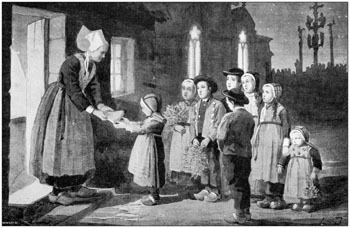
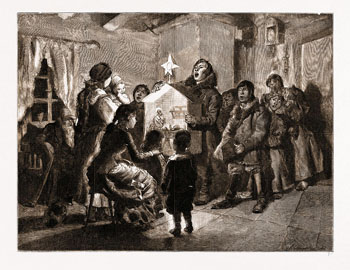
Breton children receive gifts after caroling; below, Russian carolers show a brilliant nativity scene to a peasant family
Peace and goodwill reigned amongst Catholics; all grudges and arguments were expected to be set aside during this sacred time. Many law courts even released military and political criminals whose offenses seemed reasonably pardonable. (1)
Every day during the Twelve Days after attending Mass, family and friends visited one another, sang carols, performed innocent dances, feasted on Christmas meats and sweets, and enjoyed entertaining and wholesome games.
In the late afternoon, most of the people would attend Vespers in their local church, which was performed with greater solemnity than usual. After Vespers, the people retired to their homes where they sat around the fire reciting poetry, singing carols, and telling stories of local lore, far off lands, their ancestors, and the miracles of Christmas.
Joyous dances
Many peoples performed traditional joyous dances during Christmastide. The most ancient form is the ring-dance. The Scandinavian peoples still form a circle around their Christmas tree and perform a ring-dance while singing a traditional dance carol. Villagers in Bulgaria also gather on Christmas Day for their traditional ring-dance. (2)
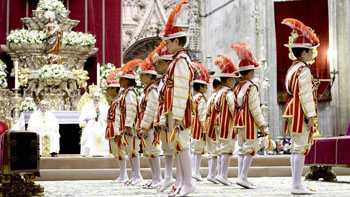
In Seville cathedral 10 boys perform the Siexes;
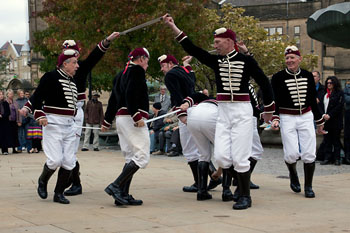
below, Englishmen perform the sword dance
In Provence, the traditional Christmas dance is the farandole in which the dancers join hands to form a long chain. One picturesque legend says that Christ was born in Provence (not in Bethlehem) and that the farandole dance originated with the Provençal shepherds who heard of Christ's Birth. (4)
After Midnight Mass in Spain, men and women filled the streets to express their joy at Christ’s Birth by dancing the Jota accompanied by songs exclaiming the joy of Christmas. (5)
In Seville Cathedral during the afternoon of Christmas day, a traditional minuet dance (the Siexes) accompanied by castanets is still performed before the high altar by 10 choir boys and dancers clad in the costume of 17th century pages. The dance begins with a song in honor of Our Lady: “Hail, O Virgin, most pure and beautiful.” (6) Up until the Pseudo-Reformation, English choir boys in York also performed a dance in the aisle of the church after Lauds on Christmas morning. (7)
Catholic Missionaries brought their joyous Christmas dances to the countries that they colonized. The French Canadians danced until dawn after Midnight Mass and the Revellion meal. (8) Even the people of Africa celebrated after Midnight Mass with dances, storytelling, songs and feasting. In Nigeria, firecrackers were thrown into the air after Mass and every one joined in the dances wearing special masks and costumes that added brilliance to the celebration. (9)

Zoque men perform the ‘Shepherd’s Dance’
The Babe who inspired all of these joyous dances was the special object of all faithful Catholic’s thoughts, especially in Austria where the dances were performed before His Crib as this carol relates:
Bring your pipes and bring your drum…
Frolic we right merrily:
He will laugh with happy glee,
Yes, and smile, and we will dance,
While He claps His tiny hands. (11)
Origin of our ancient carols
The vernacular Christmas carol is believed to have originated in 13th century Italy with St. Francis: Prior to this most of the Nativity hymns were in Latin. St. Francis desired to make the love of the Christ Child grow in the hearts of Catholics, so he celebrated the Christmas mysteries with great fervor; he introduced the charming custom of the Christmas Creche.
Soon after his death, his Franciscan sons began composing Christmas carols in Italian for the people to sing. The charm of these carols spread, inspiring first France and Spain and then the rest of Christendom, to compose their own, all with a particular charm reflecting the different regions and countries. (12)
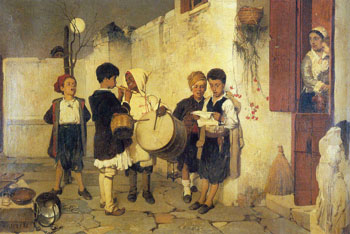
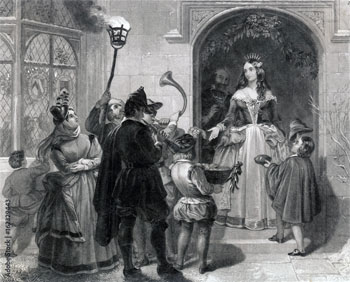
Greek boys play drums as they carol to a housewife (painting by Nikiforos Lytras); below, Wassailers offer the wassail bowl to the lady of the manor.
Some of the dearest carols are lullabies to the Christ Child. In the 13th century, these lullabies began to be sung in churches and monasteries before intricately carved cradles that held a statue of the Christ Child. One person was given the privilege to rock the cradle while the rest of the congregation sang. This charming custom is described in more detail here.
Germans and Austrians especially treasured this custom and adopted it in their own homes. Girls in Tyrol from families fortunate enough to have a Christ cradle carried it from house to house so that every family had the opportunity to rock the cradle and sing, asking for special blessings. (14)
Merry & lively caroling
Catholics in every land developed their own form of Christmas caroling in which groups of carolers roamed the streets and country lanes. Lanterns or candles lit the faces of the carolers, and characters with vibrant costumes accompanied the processions. Accompanying the carolers were instrumentalists playing fiddles, accordions, harmonicas and other regional instruments.
Often the carolers were numbered among the poor and were given gifts of food and money to help them have a proper Christmas feast. The youth of the village or groups of grown men also often caroled for coins, giving their collection to the church or sponsoring a feast for the whole village.
Every household from the King’s palace to the humblest cottage welcomed the carolers and offered them food and drink, for it was considered a great honor to be visited by these harbingers of Christmas. To ensure that newborn babes would receive this blessing, carolers in some areas of the Pyrenees sought out the houses with a new born babe. (15)
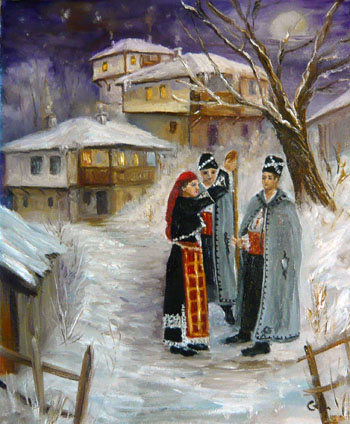
Bulgarian women place their ring-shaped buns on the stanenik’s staff.
Caroling in England and Ireland was often called Wassailing, because the carolers brought a cup or bowl of warm spiced ale – or requested the mistress to give them a cup – raised to toast the master and mistress and wish them good health and prosperity in the coming year.
There was a strict hierarchy amongst the caroling groups, which always had a designated leader. A mayoral (“chief shepherd”) who would lead the Christmas chants was elected in some Spanish villages. (17)
In Bulgaria, the man chosen to lead the carolers was known as the stanenik. Directly following Midnight Mass, all of the carolers assembled by the house of their stanenik carrying shepherd’s crooks and adorning their fur hats with wreaths of greenery or beads. The stanenik held a large branch decorated with apples, greenery, coins and ribbons upon which the women of the houses placed their special ring-shaped buns. (18)
How jubilant were the lands of Christendom during those Twelve Days of Christmas! May the examples of the past encourage Catholics today to reclaim our heritage and readopt these joyous customs. Doing this we take a stand against the secularization of society that has stripped us of these rich and joyful customs.
Continued
- Christmas in Spain (Chicago, Illinois: World Book-Childcraft International, 1983), p. 19.
- https://bnr.bg/en/post/101060648/bulgarian-christmas-and-the-tradition-of-carol-singers
- Steve Roud, The English Year (Penguin Books: 2006), p. 400.
- Christmas in France (Chicago: World-Book-Childcraft International, 1980), p. 49.
- Mary P. Pringle and Clara A. Urann, Yule-tide in Many Lands (Boston: Lothrop Lee and Shepard Co., 1916), p. 158.
- Ibid., p. 163.
- Francis X. Weiser, The Christmas Book (New York: Harcourt, Brace and Company, 1952), p. 71.
- A Celebration of Christmas, ed. Gillian Cooke (New York: G. P. Putnam’s Sons, 1980), p. 87.
- Ann Ball, Catholic Traditions in Cooking (Huntington, Indiana: Our Sunday Visitor, 1993), p. 25.
- Found on the Facebook Page of the Museo Regional de Chiapas (https://www.facebook.com/museoregionaldechiapas/posts/la-danza-de-pastoreslos-zoques-de-tuxtla-guti%C3%A9rrez-refrendan-d%C3%ADa-con-d%C3%ADa-su-iden/3406847022691186/)
- F. Weiser, The Christmas Book, p. 73.
- Ibid., pp. 58-59.
- Mary P. Pringle and Clara A. Urann, Yule-tide in Many Lands, p. 106.
- F. Weiser, The Christmas Book, p. 75.
- Christmas in Spain, p. 27.
- Pringle & Urann, Yule-tide in Many Lands, p. 134.
- A Celebration of Christmas, p. 91.
- https://bnr.bg/en/post/101060648/bulgarian-christmas-and-the-tradition-of-carol-singers



Posted January 7, 2026
______________________
______________________
 |
 |
 |
 |
 |
 |