Stories & Legends
 |
 |
 |
 |
 |
 |
 |
St. Francis of Assisi & the Spirit of Prophecy
He explains how the Seraphic Doctor, who had no instruction in the Sacred Writings, nonetheless entered deep into the mysteries of Scriptures, unraveling the knots of problems and bringing the hidden meanings into the light. Then, St. Bonaventure shows by examples how St. Francis was also gifted with the spirit of prophecy.
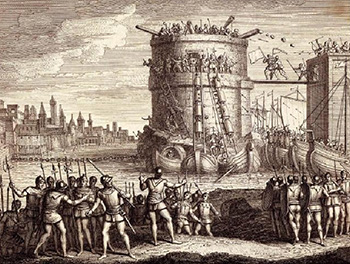
The Catholic army did not heed St. Francis’ warning during the siege of Damietta
He said to his companion: “If they go forth to join battle, the Lord has shown me that it will not fare well with the Catholics. But, if I say this, I shall be accounted a fool. If I keep silence, I shall not escape the reproaches of my conscience. What, then, do you advise?”
His companion replied: “Brother, you should esteem it but a light thing to be judged by men and being accounted a fool. Unburden thy conscience, and fear God rather than men.”
Hearing this, the herald of Christ hastened forth, and approached the Catholics with salutary warnings, forbidding the battle, and prophesying its result. The truth was to them as a vain tale; they hardened their hearts and would not turn back.
They went into the field, they joined battle, they fought, and the entire Catholic host was put to rout, thus winning shame, not triumph, as the ending of the warfare. In this dread defeat, the Catholic host was so diminished that there were about 6,000 slain or captured.
Thereby was it clearly made manifest that the wisdom of the poor man, Francis, should not have been met with contempt, for the mind of a righteous man is sometimes wont to seel more than seven watchmen who sit above in an high tower.
The death of a Knight
At another time, when he was returned from beyond the seas and had come to Celano to preach, a certain Knight with humble devoutness and great persistence invited him to dine with him. He came accordingly into the house of the Knight, and the whole household rejoiced over the coming of their poor guest.
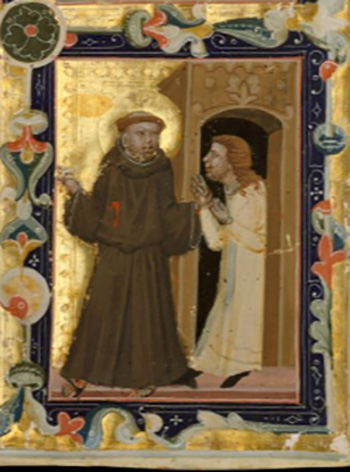
The master of the house invites Francis
to dine in his home
“Lo, my brother and host, yielding to your persistence, I have come into your house to eat. Not let you yield speedily to my exhortations. For indeed, you shall not eat this meal here, but elsewhere. So, confess now your sins, and be contrite with the grief of a true repentance, nor let anything abide in yourself that you do not lay bare in a sincere confession. The Lord will reward you this day for receiving His poor with such devoutness.”
The Knight forthwith heeded the words of the holy man, and disclosed all his sins in confession to his companion. Then he set his house in order and prepared himself, insofar as he might, for death. At length, they sat down to table, and, while the rest were beginning to eat, the host suddenly gave up the ghost, carried off by a sudden death, as predicted by the man of God.
And thus it befell, by the merits of his gracious hospitality, what is told by the Word of truth: “He that receiveth a prophet shall receive a prophet’s reward.” For because of the prophetic prediction of the holy man, that devout Knight made himself ready against the sudden onset of death. Thus, fortified by the weapons of penitence, he was able to escape eternal condemnation and enter into the everlasting tabernacles.
The ungrateful cured man
Once, while the holy man was lying sick at Rieti, a prebendary, Gideon by name, who had been stricken with a sore disease and was lying in his bed, was brought to him. With tears Gideon besought him – as did the bystanders – that St. Francis would make over him the Sign of the Cross.
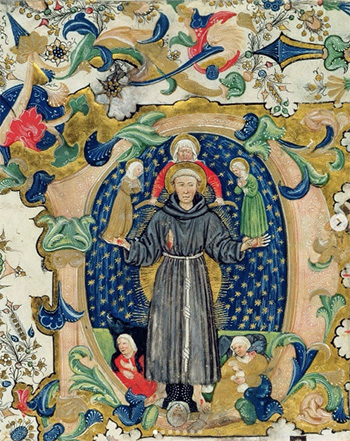
St. Francis in Glory surrounded by Chastity, Poverty & Obedience with Lust & Avarice at his feet
“Since before you were living after the lusts of the flesh, not fearing the judgments of God, how can I sign you with the Cross? Howbeit, for the sake of the devout prayers of these that plead for you, I will make over you the Sign of the Cross in the name of the Lord. Yet be well warned that a worse thing will befall you if, after you have been set free, you shall return to your vomit. For the sin of ingratitude ever bring with it worse evils than were suffered before.”
Then, when the Sign of the Cross was made over him, at once he that had lain paralyzed rose up whole, and, breaking forth into God’s praises, he cried out: “I am set free!”
Yet, when but a short time had passed by, he forgot God, and again yielded his body unto unchastity.
When one evening he had supped in the house of a certain Canon, and was sleeping there that night, all of a sudden the roof of the house fell in above them all. But while the rest escaped death, that wretched man alone was overtaken and cut off.
Thus by a righteous judgment of God the last state of that man was worse than the first, by reason of his sin of ingratitude and contempt of God, since he had not been grateful for the pardon that he had gained, and since a crime when repeated is twofold an offense.
Of truth, we must marvel at the might of the spirit of prophecy that was found in the man of God, by which he restored unto withered limbs their power, and impressed on hard hearts godliness. No less must we be astonished at the clear perception of that spirit, whereby he so foreknew the issue of future events that he could search even the secret things of men’s consciences, having obtained, like another Eliseus, a double portion of the spirit of Elias.
Excerpt from The Life of St. Francis of Assisi by St. Bonaventure,
tras. By E. Gurney Salter, NY: 1904, chap 11
Posted October 17, 2026
tras. By E. Gurney Salter, NY: 1904, chap 11
Posted October 17, 2026




______________________
______________________
 |
 |
 |