Special Devotions
 |
 |
 |
 |
 |
 |
 |
They Hated the One Who Only Did Good
The painting at right below is titled Christ Crowned with Thorns by Lucas Cranach the Elder (1472–1553). Surrounding the Divine Redeemer – Who is clad in a mocking scarlet robe – are five figures. In the foreground, a man extends a staff to Him as a scepter while, simultaneously, in a caricatured salute he tips his hat and sticks out his tongue. Beside him, another makes a face in a gesture of mockery. The others in the background strive to place upon the Savior’s beautiful Head a massive cap of thorns, like a crown.
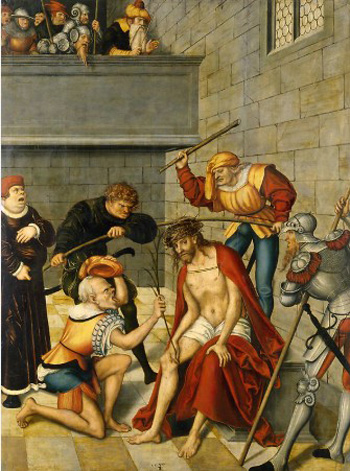
Christ Crowned with Thorns,
Lucas Cranach the Elder, 16th c.
The painting by Lucas Cranach centers on a very important aspect of the Passion: the contrast between the infinite holiness and ineffable love of the Redeemer and the unfathomable baseness and implacalbe hatred of those who tortured and killed Him. It depicts the irreducible opposition between the Light – "Erat lux vera" (Jn 1:9) – and the children of darkness; between Truth and error, Order and disorder, Good and evil.
"Popule meus, quid feci tibi? Aut in quo contristavi te?" – "O My people, what wrong have I done you, or how have I grieved you?" These words, which the Good Friday liturgy places upon the lips of Our Lord, lie at the very heart of the theme just presented. That a man should hate those who do him harm may be reprehensible, but it is not incomprehensible. But how can a man hate one who is good, one who does him good? This problem is almost as old as humanity itself. Why did Cain hate Abel? Why did the Jews persecute – and frequently kill – the prophets? Why did the Romans persecute the Christians?
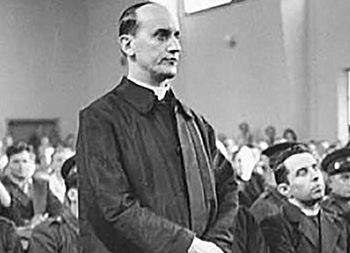
Arch. Aloysius Stepinac (1898-1960) at his mock trial in Zagreb in 1946
We know that, phrased in this manner, such questions can seem somewhat simplistic to many. The hatred of the enemies of the good was not always so unfounded. At times – and sometimes on the part of Catholics themselves – there was no lack of provocations and excesses that triggered reactions. In other instances there were misunderstandings, misinterpretations and misconceptions that gave rise to violence. There have been martyrs, then, not because the Church as such was truly known and hated, but precisely because she was unknown or unjustly maligned.
We do not deny any of this. Yet to reduce the hatred of the darkness against the Light – of the evil against the Good – to these causes alone is to oversimplify the problem. This is what becomes evident in the Passion with crystal clarity.
First, let us observe that while Catholics may have faults, Our Lord had none. No question exists about the substance and form of His preaching, the tact and timeliness with which He taught, the edifying character of His examples, the apologetic value of His miracles, or the most holy and moving aspect of His Person. For what was done to Him, He gave no pretext. He made no legitimate objection, no concrete complaint.
On the contrary, He only gave opportunities to adore Him and follow Him. Despite this, He was hated, and hated even more than His faithful would be hated throughout the centuries. How can this be explained?
It is because of this often ignored truth: In the children of darkness there exists a hatred directed precisely against Truth and Goodness. It is, therefore, futile to attempt to attribute everything to a mere interplay of misunderstandings. Indeed these existed, but they do not resolve the problem.
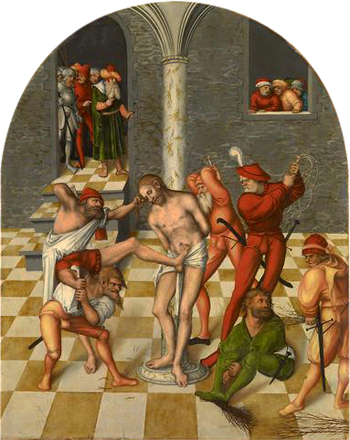
Hatred for good explains this kind of brutality toward He who did only good
We do not deny that in the majority of cases the root of hatred against God lies here. But to fully understand the problem, one must look it fully in the face.
Every sin is an offense against God. Yet there are sinners who conserve some sorrow for the evil they do and some admiration for the good they fail to do. Consequently, they repent of the lives they lead, advise others not to follow their example, and honor those who act rightly. It is by virtue of this humble attitude that Our Lord often grants them great graces and they return to the path of salvation.
If only such sinners had existed in Israel, I do not believe Jesus would have been persecuted – much less crucified. Had Cain been one of them, he would not have killed Abel. If all the sinners throughout History had been like these, the terrible persecutions of which we just mentioned would never have taken place.
How, then, are these sinners whose souls are damaged by persecution brought into the Church? That is the question.
This sorrowful and ashamed sinner described above cannot properly be called a wicked man. He will become wicked if he becomes so anesthetized by sin that he loses his sorrow over committing it as well as his admiration for those who practice virtue. A "first-degree" impiety will then emerge, so to speak, resulting in an indifference toward religion and morality.
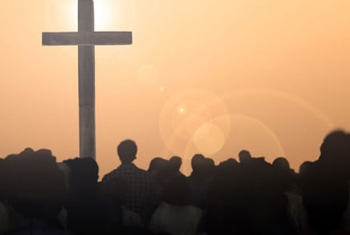
We are obliged to take a position before the Crucifixion
Obviously, such impiety is highly reprehensible. All those who witnessed the Passion in Jerusalem merely out of idle curiosity were guilty of this. The same applies to those who, throughout History – right up to the present day – consider that they can observe the fight between the children of light and the children of darkness without taking a side, acting instead as a self-serving "third force."
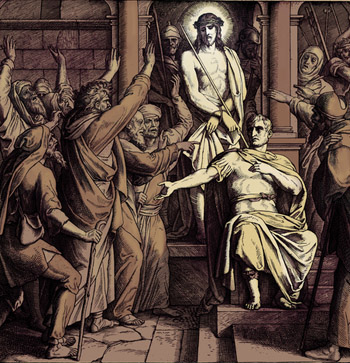
Moved by an intense hatred, the high priests demand the death of the tortured Christ
Indeed, it is commonly thought that the accursed – if they could – would all run to Heaven. This is not true. They hate God so intensely that, even if they could escape the eternal fire that engulfs them, they would not do so if it required them to perform a single act of love and obedience toward God.
Such is the power of this hatred. And it is in light of this that we truly grasp what might be termed "second-degree wickedness." It was this refined impiety that animated the Synagogue in its revolt against the Messiah. It is this same spirit that has fueled the fight of the wicked against the Church – and against faithful Catholics – throughout the centuries.
O Lord, in this hour of mercy, as we contemplate Thy Sacrosanct Body shedding Thy redeeming Blood, we ask Thee – through the infinite merits of that Most Precious Blood and through the tears of Thy Mother and ours – to keep us far from all wickedness. "Suffer us not to be separated from Thee," we implore with all our hearts.
In all places where the wicked persecute the children of light, may Thou be the strength of the persecuted, not only so they do not lose heart, but so they may rise up, make themselves heard and crush the adversary. Through the Immaculate Heart of Mary, we implore this of Thee.
And since, even at the last hour, Thou didst promised Paradise to the good thief, O Lord, by the merits of Thy Agony, we implore, in union with Mary Most Holy, that Thy mercy descend into the very depths of wickedness, so as to invite even Thy worst adversaries onto the paths of virtue.
Further, in Thy mercy, Lord, confound, humble and reduce to utter powerlessness those who reject the most urgent appeals of Thy love and persist in laboring to destroy Christian Civilization and even – were it possible – Thy mystical Spouse, the Holy Church.



Catolicismo n. 112 – April 1960
Posted March 27, 2026
Posted March 27, 2026
______________________
______________________

 |
 |
 |
 |
 |
 |
 |
 |
 |