American History
 |
 |
 |
 |
 |
 |
 |
California’s San Juan Capistrano Mission - III
Prayers, Songs & Wakes of
Old San Juan Capistrano
Charles Sauders recounts songs and customs that had continued into the early 20th century in the old mission town San Juan Capistrano, as told to him Fr. John O'Sullivan.
Once Fr. O’Sullivan was asked if the famous description of how the people sang the Dawn Hymn in Helen Hunt Jackson’s novel Ramona was based on an actual custom.
In the book Capistrano Night: Tales of a California Mission, author Charles F. Saunders records the following account told to him by Fr. O’Sullivan:
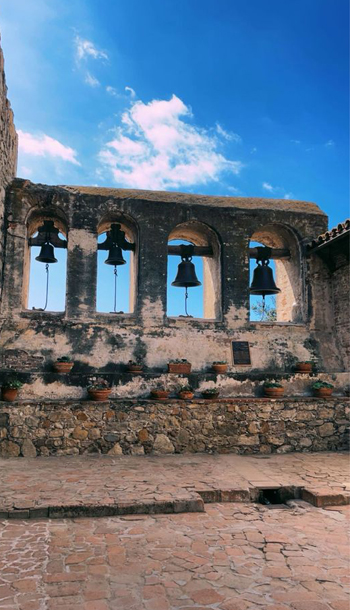
At daybreak the Angelus bells rang and all in the house would arise to say the prayer and sing El Alba
Doña Balbineda, who was born here in the Mission building, says that her mother remembered how the rough voices of the soldiers in the cuartel, or guardhouse, could be heard joining in it just as day broke. And Doña Maria has told me that when she was a little girl on her father’s ranch, it was the practice of the family to sing it every weekday morning, muy temprano, very early, as she expressed it.
At the first sign of light, her father’s voice resounded through the house, calling “Levántase, muchachos, y asiéntense á resar” - Rise, children, and sit up to pray!
Thereupon all the family would sit up in bed and repeat the Angelus: “El ángel del Señor anunció a María.” And as soon as this was concluded, el Alba was started. There was no getting out of it. If any did not awake, they were made to awake. And the little María, who was the baby of the family, would thrust her head back into the pillow as soon as the prayer and song were ended for another nap.
There are versions of the Alba with as many as a dozen stanzas or even more, but Doña María’s family used only three. She has given these to me just as she sang them when a child:
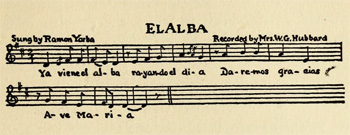
Digamos todos, Ave María!
Nació María, para consuelo
De pecadores, y luz del Cielo.
Viva Jesús, Viva María,
Viva tambien, la luz de dia!
Now comes the dawn breaking is day.
Let us all say, Hail, Mary!
Mary was born, for the consolation
Of sinners and as the light of Heaven.
Praised be Jesus, praised be Mary,
Praised be also, the light of day!
On Sundays there was substituted for the alba an alabanza, or "praise" to the Virgin, sung in many stanzas, of which this is the first:
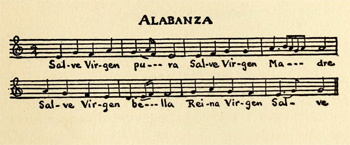
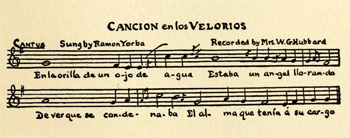
On Sundays an Alabanza replaced El Alba; below, the Song of the Wakes or Velarios
Salve, Virgen bella, Reina Virgen, salve!
Hail, Virgin immaculate, Hail, Virgin Mother,
Hail, Virgin beautiful. Queen Virgin, hail!
While the Father was telling me of these matters and humming the airs of the hymns, I noticed that his faithful ama de llaves, or housekeeper, was hovering about the doorway. At the conclusion of the Alabanza she called to him softly. He went out to her and after a moment returned, saying with an apologetic smile:
“I have not been very well today, and Cándida thinks I am overdoing my strength by sitting up longer. She may be right so, if you will excuse me, I think it will be best for me to retire, and I will see you again tomorrow. Meantime you may find entertainment in looking through these libritos” – handing me several notebooks from the desk – “and so, if you don’t mind, adios, hasta mañana!”
Thus left to myself, I spent an hour or two culling out tidbits. Some of these on old customs carried on the spirit in which the evening had begun, and I will share them with you.
Night & morning prayers
Here is a prayer of the children, a Spanish counterpart of our “Now I lay me now to sleep.” It is credited to Doña María. “I always liked,” she says, “ to see them on their little knees, their little hands put together (las manitas puestas).”
Con Dios me acuesto, con Dios me levanto,
Con la gracia de Díos y la del Espíritu Santo.
Quien benedició el câliz, la noche y la cena
Bendiga mi cama y a quien duerme en ella.
A mi casa de canto a canto, que no llegue cosa mala,
Mas que Díos y el Espíritu Santo.
With God I lie down, With God I arise.
With the Grace of God and the Holy Ghost.
He who blessed the chalice, the night and the supper,
Bless my bed and the one sleeps in it.
To my home from edge to edge, let no evil come,
Only God and the Holy Ghost.
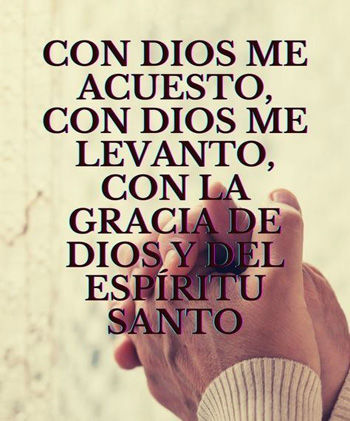
Con Diós me acuesto, con Diós me levanto,
Con la gracia de Diós y el Espíritu Santo.
La Virgen me tape con su velo y con su manto,
Sin que nadie me tiente, solo Dios y el Espíritu Santo.
With God I lie down, with God I arise.
With the grace of God and the Holy Ghost.
May the Virgin cover me with her veil and mantle,
So no one may tempt me, only God and the Holy Ghost.
Grace before & after meals
There were many forms of grace before and after meals. I like the inclusiveness of this one:
Gracías te doy, O gran Señor, por el sustento que me das aunque yo no lo merezco, y que las ánimas del Purgatorio descansen en paz. Amen.
I give thee thanks, O great Lord, for the food thou givest me even though I do not merit it, and may the souls in Purgatory rest in peace. Amen.
The song of the wakes
Of dramatic interest I found the Song of the Wakes, sung at the velorios or wakes over the body of the dead – a custom still observed at San Juan (in the 1920s).
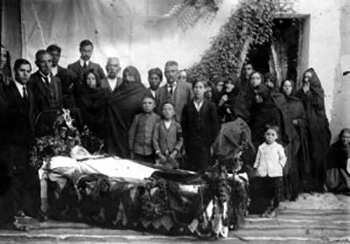
The serious atmosphere of the Mexican wake in old San Juan Capistrano
All night long the mourners remain, joining from time to time in reciting the Rosary as well as singing the song that follows below, until finally at the first appearance of light in the east, El Alba, the Dawn Hymn is begun. The vividness of the Spanish original is but poorly reflected, I am afraid, in my literal translation.
|
I. Orillas de un ojo de agua Estaba un ángel llorando, De ver que se condenaba El alma que tenía á su cargo. II. La Virgen le dice al ángel: No llores, ángel varon, Que yo pediré a mi Hijo Que esta alma alcanze perdon. Ill. Hijo querido llamado, Hijo de mi corazón, Por la leche que mamastes Que esta alma alcanze perdón. IV. Madre querida llamada, Madre de mi corazón, Como quieres que perdone Si en tanto nos ofendió? V. Hijo querido llamado, Hijo de mi corazón, Pastoreando sus ovejas Un Rosario me rezó, VI. Madre querida llamada, Madre de mi corazón, Si tanto quieres est’ alma, Pues sacala de ese ardor. VII. La Virgen como piadosa Al infiemo se arrojó, Con su santo ‘scapulario De la mano lo sacó. VIII. Sale el diablo envenenado Para los cielos tiró: Señor, el alma que me has dado Tu Madre me la quitó. IX. Quítate de aquí, Lucifer, Tu no eres mas de un traidó, Pues lo que mi Madre hiciera Por bien hecho lo doy Yo. X. Los angeles en el cielo Toditos à un loor: El Señor nos de la gloria Como se la dió al pastor. XI. El Rosario de Maria No lo dejes de rezar. Es el primer escalón Que al cielo hemos de llegar. |
I. On the bank of a spring Was an angel weeping, To see forever damned The soul he had in his care. II. Says the Virgin to the angel: Weep not, manly angel, I will obtain from my Son For this soul a pardon. III. O beloved Son. Son of my heart, By the milk of my breasts Let this soul receive pardon. IV. O dearest Mother, Mother of my heart, Why askest thou pardon For one who has offended us so much? V. O my beloved Son, Son of my heart, Shepherding his sheep, A Rosary he prayed to me. VI. O dearest Mother, Mother of my heart, Since thou lovest this soul so much, Pluck it from the flame. VII. The Virgin filled with pity Descended to hell, With her holy scapular She pulled him out by the hand. VIII. The venomous devil went out And drew near to heaven: ‘Lord, the soul Thou didst give me, Thy mother has taken from me.’ IX. Away from here, Lucifer, You are nothing but a traitor, Whatever my mother has done, I will consider it well done. X. The angels in heaven All with one praise: May the Lord give us glory As He gave it to the shepherd!” XI. The Rosary of Mary Fail not to pray, It is the first step we must take To reach Heaven |
The song is rich in the good Catholic doctrine: how the Judgment is hard, but the intercession of Our Lady can sway the balance on the scales and save a soul condemned to Hell. Thus the importance of praying the Rosary, “the first step we must take to reach Heaven.”
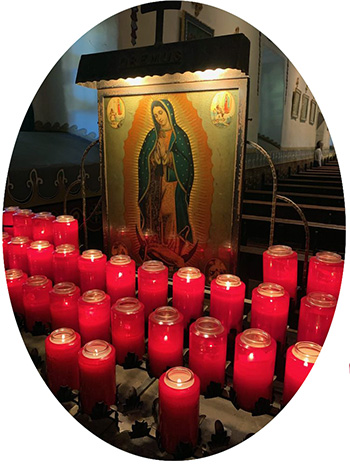
Candles always lit before Our Lady
of Guadalupe in Serra Chapel,
San Juan Capistrano



Excerpt from Capistrano Night: Tales of a California Mission
NY:Robert McBride & Co, 1930, Pp 154-166
.Posted May 2, 2026
NY:Robert McBride & Co, 1930, Pp 154-166
.Posted May 2, 2026
______________________
______________________
 |
 |
 |
 |
 |
 |