Book reviews
 |
 |
 |
 |
 |
 |
 |
A Traditional Catholic Response
to Progressivism & Vatican II
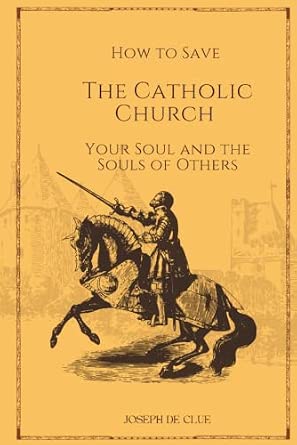
Review of How to Save the Catholic Church, Your Soul and the Souls of Others by Joseph De Clue, 2026, 127 pp.
Purchase it here
One could be tempted to whisper that the gates of Hell have prevailed against her. But it is not so. And that is what Joseph De Clue wants to assure you in his concise work.
The author’s proposal to the faithful is not to become discouraged or enter into despair because of the compromises and problems with the new liturgy that came from Vatican II. It is important to note that he is not just speaking of the Novus Ordo Missae and its novelties and atrocities. He also holds unacceptable the 1962 Missal, the Mass adopted by the "indult" communities such as the Fraternity of St. Peter, the SSPX, the Institute of Christ the King, etc.
De Clue’s position on this matter is what I appreciate most in his work: He does not accept compromise when it comes the question of which Mass to attend. In Chapter 7, he explains why the pre-’55 Mass matters and why the ’62 Missal is not enough.
TIA has a whole series of articles on our site by Dr. Carol Byrne which explains the dangerous and tendentious changes made by Pope Pius XII in 1955, especially in the Holy Week ceremonies. As for the ’62 Missal, it may come as a shock to many conservative and traditional Catholics to know that it was actually the super-progressivist and recognized Freemason Fr. Annibale Bugnini who master-minded this Missal.
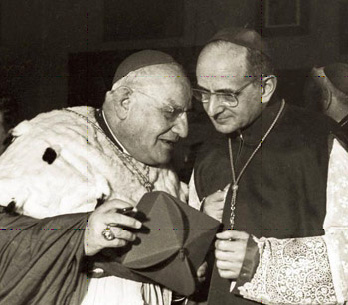
John Paul I & Card. Montini (later Paul VI) were allies in the progressivist reforms
As the author notes, “Lex orandi, lex credendi: the way you pray shapes the way you believe. If tradition was tampered with once, more tampering always follows. Sticking with the pre ’55 books is like drawing a firm line in the sand: Here the Catholic Religion is intact. Beyond this, the demolition began.” (p. 20)
Mr. De Clue challenges his readers to draw that firm line in the sand: that is, to find a Catholic priest who will say the pre-1955 Mass and then support him and assist at it. (I add here, as a side note not mentioned by the author, that many of the Eastern Catholic rites have not adopted changes to their liturgies, and could also be attended if they are available.)
To begin, one would have to look for an independent priest. A difficult, but not impossible task if determination and commitment is present among a small group of faithful, or even one person. De Clue repeatedly reminds readers: The change starts with one; then he invites you to become that one.
A practical manual
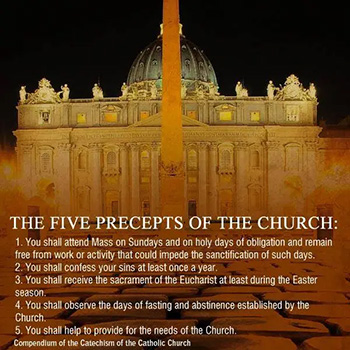
What every Catholic once knew
has been lost since Vatican II
One chapter is dedicated to the common objections: “The children will not sit still,” “We cannot afford it,” “I’m afraid of doing it wrong,” “We are too few,” “What if we lose friends and family?” The answers are concise, constructive, accessible and Catholic.
At the end of the book are the extremely useful Appendices, which set out in an easy to understand language the principles once taught in Catholic elementary schools by dedicated nuns, but today are almost lost from neglect: that is, the precepts of the Church, Sundays and Holy Days of Obligation, the Fast and Abstinence rules, a list of Key Catholic Terms, and useful Resources.
Deepening the foundation
In Part III, the author sets out an important and today often-forgotten truth: “The Catholic Religion is not a feeling or a private opinion. … It is ordered, coherent, and grounded in first principles that do not change.” In short, the Faith is objective, ordered and knowable.
Thence, the importance of apologetics, which is the disciplined use of reason and evidence to demonstrate the truths of our Faith. Catholics must not just assist at a Mass and say their prayers; they should study the basics of the Catholic Faith and be prepared to defend its truths. To know the Faith is necessary to practice the vigilance and militancy needed for sustaining and strengthening it: for oneself, one’s family, one’s parish and community.
This disciplined study is the beginning of the journey to become a truly militant Catholic, which we are called to be as a member of the Church Militant (another term swept under the mat after Vatican II). The book cover is an excellent illustration of this point.
Having said this, I make one suggestion to Mr. De Clue, which is to compose a second short book in this same easy, nuts-and-bolts style. Its topic could pick up where this one ends: We have our priest, our Mass, our spiritual life, our study. Now, let us not just fade away Thoreau-style in the woods with our families and little community; but enter the active fight for the restoration of our Holy Mother Church and a truly Catholic Civilization.
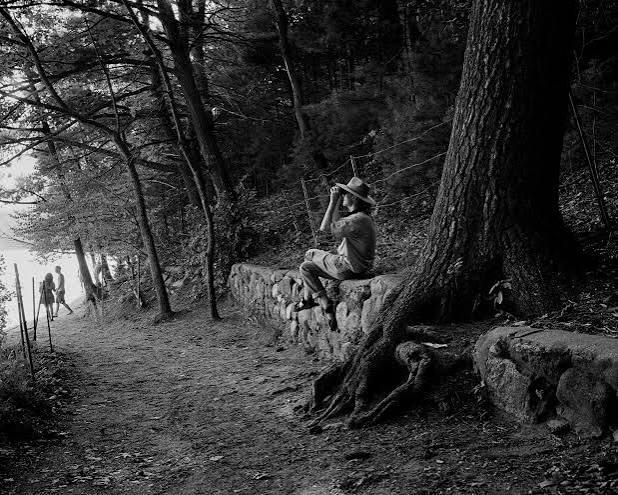
The militant Catholic should not just disappear to live in nature & forget the fight
Unless a person, a family, and a community engage in an active fight to destroy the Revolution in society and the Church, there can be no restoration. We cannot just retreat with the Mass and our private devotions. We must expose the enemies and condemn them, uncover the heresies and debunk them.
We must also fight to restore the good customs and manners of Catholic daily life – the modest dress, refined language and civilized treatment of others that reflect the high respect for ourselves and our neighbor we should have as made in the image and likeness of God.
If a traditional priest is only saying the Mass and not actively preaching against the errors, then his parishioners will find themselves and their families still immersed in the revolutionary, vulgar and egalitarian spirit of our days.
So, once again, it falls to each one to take up the full fight, one at a time, as De Clue consistently reminds us, so that each of us can play our part – be it small or large – in the full restoration Our Lady promised at Quito and Fatima.
Posted October 23, 2026



______________________
______________________
 |
 |
 |
 |
 |
 |