Saints of the Day
 |
 |
 |
 |
 |
 |
 |
St. Teresa of Avila – II – October 15
Biographical Selection:
Teresa of Avila (1515-1582) had to experience more than mere human privation. There came a time when God Himself seemed to fail her. Like St. Philip Benisi of Damino before her and St. Joseph Calasanz and St. Alphonsus of Ligouri after her, she saw herself, her daughters and her sons, condemned and rejected in the name and by the authority of the Vicar of Christ.
 It was one of these occasions, long before prophesied, when it is given to the beast to make war with the saints and to overcome them (Apoc 13:7) We have not space here to relate all the sad circumstances, and why should we do so? The old enemy had then one manner of acting, which he repeated in the 16th, 17th and 18th centuries, and will always repeat.
In like manner, God has but one aim in permitting the evil, viz: to lead his chosen ones to that lofty summit of crucifying union, where He, Who willed to be first to taste the bitter dregs of the chalice, could say more truly and more painfully than any other: “My God, My God, why hast Thee forsaken Me?”
Comments of Prof. Plinio:
It is with truly eloquent words that Dom Guéranger reports here the moral martyrdom of St. Teresa.
You know that she was first a Calced Carmelite, a branch of the Carmelite Order of which we are Third Order members. She wanted to reform the Carmelite Order. That reform had the aim of restoring sacrifice and penance, which had faded away centuries before and in her days had practically disappeared. Several Popes had successively allowed one mitigation of the Rule after another for the Carmelite Order, whose convents had been transformed into hotels.
The nuns used to leave the convents at will. During the day in the cloisters of the convents one could hear worldly love songs played with guitars, a very common recreation in the Spain of that time. The nuns received all types of visits; the food was delectable; strict obedience had disappeared, and nothing was left of the Spirit of St. Elias, its Founder.
 After years of a lax monastic life, she was touched by grace at age 39 and resolved to start the Teresian Reform by establishing truly observant and austere Carmelite convents. This work – which should have been met with universal enthusiasm – instead received a tremendous opposition. All of Hell – and a part of earth as well – seemed to go against her, since an enormous part of our earth is under the direction of Hell. Among other opponents to her reform were her own Carmelite brothers and sisters, the religious authorities and, finally, Rome.
When she had already founded many Discalced Carmelite convents and the Teresian Reform was advancing, a decree from Rome arrived commanding her to end her Reform, dissolve the convents and order the nuns to return to the lax convents. It was the victory of relaxation over observance, of softness over zeal, of the Revolution over the Counter-Revolution, to speak in today’s terms. It was a tremendous trial for her. It was one of the worse days of her life. She prayed ardently and wrote letters to all her relations and influential friends asking them to act.
One of those letters was addressed to King Philip II, whom she called “nuestro santo Rei Felipe” (our holy King Philip). Philip II called the Apostolic Nuncio to ask why that order had been issued by the Pope.
Philip II was a very intimidating person. He used to strike so much fear in those who approached him that when they were received by him in the Escorial Palace, they became so nervous he had to tell them, “Sosegaos” – “Be calm.”
One anecdote says everything: One day when the King was at his Court with a considerable number of nobles, one of them approached Philip II and told him a joke. At the end, when the noble was expecting a guffaw of approval, the King addressed him with a severe face: “Con el Rey no se juega!” (With the King no one should joke!) The next day that noble died of grief.
The historians report that the Nuncio also was very afraid of the King and agreed to everything Philip II wanted. This is how Philip II stepped in to prevent the Teresian Reform from ending.
 Thus, Philip II gave a decisive support to stop the deterioration of the Carmelite Order and contributed to the development of one of the most active pillars of the Counter-Reformation against Protestantism.
From it came all the glories that the Reformed Carmelite Order gave to the Church – it suffices to mention St. Therese of Lisieux and we need say nothing else. All this came from the friendship of those two great personalities in Church History: St. Teresa of Avila and King Philip II, who are like two constellations in the firmament of the Church.
I believe that by preventing the Teresian Reform from ending, Philip II won a victory much greater than if he had conquered England with the Invincible Armada. To have a truly penitent contemplative Order that acts as the lighting rod to prevent God from sending a chastisement from falling on the earth is much more than to perform great military and political deeds.
The trust St. Teresa had in Divine Providence allowed her to pass through this tremendous trial – the attack from both Hell and the powers of earth. In the end God rewarded her confidence and allowed her extraordinary Reform of the Carmelite Order to be accomplished for His glory and the exaltation of Holy Mother Church.
Today, the Carmelite Order and the whole Catholic Church is passing through a much greater universal crisis, which is the infiltration of Progressivism into everything.
We should ask St. Teresa to give us the confidence that she had and the certainty that the Catholic Church will be reborn from the present apocalyptic ordeal more brilliant and holy than ever to inspire the greatest era of History, which will be the Reign of Mary.


The Saint of the Day features highlights from the lives of saints based on comments made by the late Prof. Plinio Corrêa de Oliveira. Following the example of St. John Bosco who used to make similar talks for the boys of his College, each evening it was Prof. Plinio’s custom to make a short commentary on the lives of the next day’s saint in a meeting for youth in order to encourage them in the practice of virtue and love for the Catholic Church. TIA thought that its readers could profit from these valuable commentaries.
The texts of both the biographical data and the comments come from personal notes taken by Atila S. Guimarães from 1964 to 1995. Given the fact that the source is a personal notebook, it is possible that at times the biographic notes transcribed here will not rigorously follow the original text read by Prof. Plinio. The commentaries have also been adapted and translated for TIA’s site.
Teresa of Avila (1515-1582) had to experience more than mere human privation. There came a time when God Himself seemed to fail her. Like St. Philip Benisi of Damino before her and St. Joseph Calasanz and St. Alphonsus of Ligouri after her, she saw herself, her daughters and her sons, condemned and rejected in the name and by the authority of the Vicar of Christ.
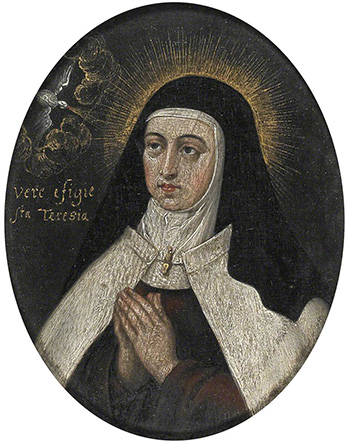
St Teresa of Avila (1515-1582)
In like manner, God has but one aim in permitting the evil, viz: to lead his chosen ones to that lofty summit of crucifying union, where He, Who willed to be first to taste the bitter dregs of the chalice, could say more truly and more painfully than any other: “My God, My God, why hast Thee forsaken Me?”
Comments of Prof. Plinio:
It is with truly eloquent words that Dom Guéranger reports here the moral martyrdom of St. Teresa.
You know that she was first a Calced Carmelite, a branch of the Carmelite Order of which we are Third Order members. She wanted to reform the Carmelite Order. That reform had the aim of restoring sacrifice and penance, which had faded away centuries before and in her days had practically disappeared. Several Popes had successively allowed one mitigation of the Rule after another for the Carmelite Order, whose convents had been transformed into hotels.
The nuns used to leave the convents at will. During the day in the cloisters of the convents one could hear worldly love songs played with guitars, a very common recreation in the Spain of that time. The nuns received all types of visits; the food was delectable; strict obedience had disappeared, and nothing was left of the Spirit of St. Elias, its Founder.
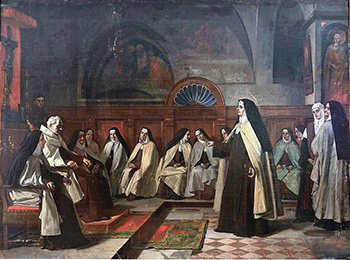
St Teresa defends her reform before the Carmelite provincial Jerónimo Gracián
When she had already founded many Discalced Carmelite convents and the Teresian Reform was advancing, a decree from Rome arrived commanding her to end her Reform, dissolve the convents and order the nuns to return to the lax convents. It was the victory of relaxation over observance, of softness over zeal, of the Revolution over the Counter-Revolution, to speak in today’s terms. It was a tremendous trial for her. It was one of the worse days of her life. She prayed ardently and wrote letters to all her relations and influential friends asking them to act.
One of those letters was addressed to King Philip II, whom she called “nuestro santo Rei Felipe” (our holy King Philip). Philip II called the Apostolic Nuncio to ask why that order had been issued by the Pope.
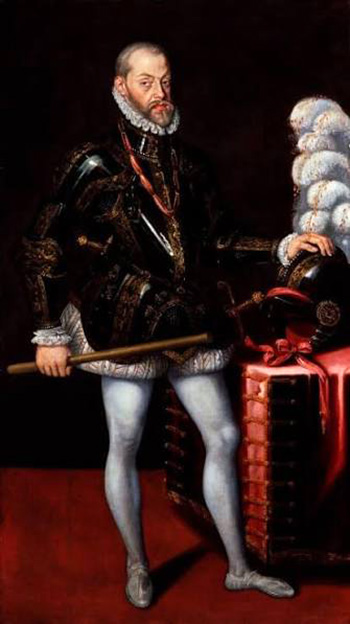
Philip II was a very intimidating person. He used to strike so much fear in those who approached him that when they were received by him in the Escorial Palace, they became so nervous he had to tell them, “Sosegaos” – “Be calm.”
One anecdote says everything: One day when the King was at his Court with a considerable number of nobles, one of them approached Philip II and told him a joke. At the end, when the noble was expecting a guffaw of approval, the King addressed him with a severe face: “Con el Rey no se juega!” (With the King no one should joke!) The next day that noble died of grief.
The historians report that the Nuncio also was very afraid of the King and agreed to everything Philip II wanted. This is how Philip II stepped in to prevent the Teresian Reform from ending.
Philip II, an imposing figure who stepped into save the Teresian Carmelite reform
From it came all the glories that the Reformed Carmelite Order gave to the Church – it suffices to mention St. Therese of Lisieux and we need say nothing else. All this came from the friendship of those two great personalities in Church History: St. Teresa of Avila and King Philip II, who are like two constellations in the firmament of the Church.
I believe that by preventing the Teresian Reform from ending, Philip II won a victory much greater than if he had conquered England with the Invincible Armada. To have a truly penitent contemplative Order that acts as the lighting rod to prevent God from sending a chastisement from falling on the earth is much more than to perform great military and political deeds.
The trust St. Teresa had in Divine Providence allowed her to pass through this tremendous trial – the attack from both Hell and the powers of earth. In the end God rewarded her confidence and allowed her extraordinary Reform of the Carmelite Order to be accomplished for His glory and the exaltation of Holy Mother Church.
Today, the Carmelite Order and the whole Catholic Church is passing through a much greater universal crisis, which is the infiltration of Progressivism into everything.
We should ask St. Teresa to give us the confidence that she had and the certainty that the Catholic Church will be reborn from the present apocalyptic ordeal more brilliant and holy than ever to inspire the greatest era of History, which will be the Reign of Mary.


  | |
|
|
The texts of both the biographical data and the comments come from personal notes taken by Atila S. Guimarães from 1964 to 1995. Given the fact that the source is a personal notebook, it is possible that at times the biographic notes transcribed here will not rigorously follow the original text read by Prof. Plinio. The commentaries have also been adapted and translated for TIA’s site.