Saints of the Day
 |
 |
 |
 |
 |
 |
 |
Our Lady Aparecida – II – October 12
It is simultaneously a curious and edifying fact in the life of the Church that, as the depositary of the loftiest and more complex theological truths, the mass of the faithful – gifted with a special acumen – can nonetheless grasp and live these truths even when its cultural level would seem to bar them access to any intellectual activity of a higher order.
In everything related to devotion to Our Lady, this observation is proved with the greatest clarity. In previous articles, I presented the doctrine of St. Grignion de Montfort regarding true devotion to Our Lady, and I tried to show my readers the strength and depth of the arguments upon which the Church bases her Marian doctrine.
 As the readers can see, Marian doctrine and devotion to Our Lady have grown steadily, developing not through a succession of merely literary, emotional hyperboles that
try to outdo one another, but rather like a tower of reasoning, as solid as granite, to which each generation of theologians adds more stories, firmly grounded in the diligent effort of reason to uncover the full scope and extent of revealed truths.
As the readers can see, Marian doctrine and devotion to Our Lady have grown steadily, developing not through a succession of merely literary, emotional hyperboles that
try to outdo one another, but rather like a tower of reasoning, as solid as granite, to which each generation of theologians adds more stories, firmly grounded in the diligent effort of reason to uncover the full scope and extent of revealed truths.
At the same time, it is moving to observe how the people’s piety – often without knowledge of the arguments of Sacred Theology and guided largely by the keenness of their own sensibility – penetrates to the very core of the theological revealed truths taught by the Church. Further, they know how to live out such truths with an authenticity of conviction and sentiment that could not be explained apart from the action of the Holy Spirit.
St. Grignion de Montfort shows that the great truths about the supernatural maternity of Our Lady over men and her universal mediation are corroborated by the fact that this devotion to her has spread to every corner of the globe. Indeed, there is not a single people who does not claim to be specially loved by Our Lady -- and with good reason because it is the nature of mother’s heart, no matter how numerous her children may be, to bestow a special love upon each one, based on unique bonds.
There is no people who does not have at least one great national Shrine erected in honor of the Blessed Virgin Mary, where the Queen of Heaven showers spiritual and temporal graces with abundance on the faithful. Further, in each region there is a Church or a Chapel specially venerated by the faithful, and in each Church or Chapel there is at least one image of Our Lady. This rule applies without exception to the most diverse nations of the world, from Poland to the African jungle, from Brazil to China [this article was written in 1939, before China fell into Communism].
What is the reason for the absolute universality of this veneration – a universality that, while strictly in accord with the teaching of the Church – is distinguished by the remarkable spontaneity of the expressions through which it expresses itself? The Church has never commanded each people to erect a Shrine dedicated to Our Lady, nor did she require that Our Lady have a dedicated altar in each church. Ecclesiastical authority never sought to oblige the faithful to offer Our Lady all the acts of piety with which she is venerated.
The Church limited herself to defining Marian truths; then, for the most part, the enthusiastic and spontaneous piety of the faithful has followed its own course. So, we can assert that almost all the feasts of Our Lady, and nearly all the forms of piety with which she is honored, were born spontaneously from the mass of the faithful or through private revelations, only to be subsequently approved by the Church.
Why is this? It is because the people’s piety feels deeply and vividly that Our Lady is truly the Mother of all mankind, and especially of those who dwell in the fold of the Catholic Church. It also senses that Our Lady’s mediation is the sure, direct and certain gateway to access to the Throne of the Creator.
Making these reflections, I am invincibly reminded of Nossa Senhora Aparecida, and the profound impressions I have always received whenever I go there to pray at Our Lady’s feet.
Where else in all of Brazil is there a place toward which the eyes of all Brazilians turn with such unwavering constancy? What words among us has the gift of opening hearts so readily? What invocation speaks to the Brazilian sensibility more ardently than Aparecida to correct its course and ennoble its supernatural ends?
Who, upon hearing the name Our Lady of Aparecida, does not recall the ardent supplications of mothers praying for their sick children or of families weeping in destitution and misery over lost well-being as they turn to the Throne of the Queen of Clemency? Who has not found comfort there when their homes are broken by infidelity, their hearts wounded by abandonment and misunderstanding? Those wandering in the realm of error in search of the midday splendor of Truth, those who have been led astray onto the roads of vice and seek the Way, souls dead to the life of grace longing to find in the darkness the fountains of a new Life – do they not all turn to her?
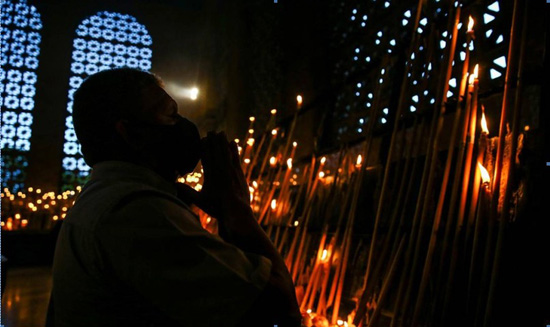
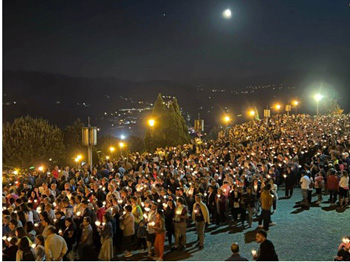 Where can we feel more intensely the burning heat of heart-rending pleas and the magnificent joy of triumphal thanksgivings? Where, more precisely, can one hear the Brazilian heart – weeping, suffering, imploring, triumphing through prayer, rejoicing, and giving thanks – better than at Aparecida? And, above all, where is the action of God more visible – in His constant outpouring of graces – than in that blessed village that Divine Providence established as the fiefdom of the Queen of Heaven?
In Aparecida the air is so saturated with the effluvia of prayer and the dew of grace that everyone clearly senses that Aparecida was designed by Divine Providence to be the spiritual capital of the country.


The Saint of the Day features highlights from the lives of saints based on comments made by the late Prof. Plinio Corrêa de Oliveira. Following the example of St. John Bosco who used to make similar talks for the boys of his College, each evening it was Prof. Plinio’s custom to make a short commentary on the lives of the next day’s saint in a meeting for youth in order to encourage them in the practice of virtue and love for the Catholic Church. TIA thought that its readers could profit from these valuable commentaries.
The texts of both the biographical data and the comments come from personal notes taken by Atila S. Guimarães from 1964 to 1995. Given the fact that the source is a personal notebook, it is possible that at times the biographic notes transcribed here will not rigorously follow the original text read by Prof. Plinio. The commentaries have also been adapted and translated for TIA’s site.
In everything related to devotion to Our Lady, this observation is proved with the greatest clarity. In previous articles, I presented the doctrine of St. Grignion de Montfort regarding true devotion to Our Lady, and I tried to show my readers the strength and depth of the arguments upon which the Church bases her Marian doctrine.
From the top, Our Lady Aparecida, Our Lady of Guadalupe, Our Lady of Czestochowa, Our Lady of Carmel & Our Lady of La Salette
At the same time, it is moving to observe how the people’s piety – often without knowledge of the arguments of Sacred Theology and guided largely by the keenness of their own sensibility – penetrates to the very core of the theological revealed truths taught by the Church. Further, they know how to live out such truths with an authenticity of conviction and sentiment that could not be explained apart from the action of the Holy Spirit.
St. Grignion de Montfort shows that the great truths about the supernatural maternity of Our Lady over men and her universal mediation are corroborated by the fact that this devotion to her has spread to every corner of the globe. Indeed, there is not a single people who does not claim to be specially loved by Our Lady -- and with good reason because it is the nature of mother’s heart, no matter how numerous her children may be, to bestow a special love upon each one, based on unique bonds.
There is no people who does not have at least one great national Shrine erected in honor of the Blessed Virgin Mary, where the Queen of Heaven showers spiritual and temporal graces with abundance on the faithful. Further, in each region there is a Church or a Chapel specially venerated by the faithful, and in each Church or Chapel there is at least one image of Our Lady. This rule applies without exception to the most diverse nations of the world, from Poland to the African jungle, from Brazil to China [this article was written in 1939, before China fell into Communism].
What is the reason for the absolute universality of this veneration – a universality that, while strictly in accord with the teaching of the Church – is distinguished by the remarkable spontaneity of the expressions through which it expresses itself? The Church has never commanded each people to erect a Shrine dedicated to Our Lady, nor did she require that Our Lady have a dedicated altar in each church. Ecclesiastical authority never sought to oblige the faithful to offer Our Lady all the acts of piety with which she is venerated.
The Church limited herself to defining Marian truths; then, for the most part, the enthusiastic and spontaneous piety of the faithful has followed its own course. So, we can assert that almost all the feasts of Our Lady, and nearly all the forms of piety with which she is honored, were born spontaneously from the mass of the faithful or through private revelations, only to be subsequently approved by the Church.
Why is this? It is because the people’s piety feels deeply and vividly that Our Lady is truly the Mother of all mankind, and especially of those who dwell in the fold of the Catholic Church. It also senses that Our Lady’s mediation is the sure, direct and certain gateway to access to the Throne of the Creator.
Making these reflections, I am invincibly reminded of Nossa Senhora Aparecida, and the profound impressions I have always received whenever I go there to pray at Our Lady’s feet.
Where else in all of Brazil is there a place toward which the eyes of all Brazilians turn with such unwavering constancy? What words among us has the gift of opening hearts so readily? What invocation speaks to the Brazilian sensibility more ardently than Aparecida to correct its course and ennoble its supernatural ends?
Who, upon hearing the name Our Lady of Aparecida, does not recall the ardent supplications of mothers praying for their sick children or of families weeping in destitution and misery over lost well-being as they turn to the Throne of the Queen of Clemency? Who has not found comfort there when their homes are broken by infidelity, their hearts wounded by abandonment and misunderstanding? Those wandering in the realm of error in search of the midday splendor of Truth, those who have been led astray onto the roads of vice and seek the Way, souls dead to the life of grace longing to find in the darkness the fountains of a new Life – do they not all turn to her?
Aparecida received 10.5 million pilgrims in 2025
In Aparecida the air is so saturated with the effluvia of prayer and the dew of grace that everyone clearly senses that Aparecida was designed by Divine Providence to be the spiritual capital of the country.
The effluvia of prayers saturate the atmosphere of Aparecida
This article was first published in
O Legionario, on December 17, 1939
O Legionario, on December 17, 1939


  | |
|
|
The texts of both the biographical data and the comments come from personal notes taken by Atila S. Guimarães from 1964 to 1995. Given the fact that the source is a personal notebook, it is possible that at times the biographic notes transcribed here will not rigorously follow the original text read by Prof. Plinio. The commentaries have also been adapted and translated for TIA’s site.