Saints of the Day
 |
 |
 |
 |
 |
 |
 |
St. Hyacinth of Poland – August 17
Biographical Selection:
St. Hyacinth (1185-1257) belonged to the Order of the Preachers – the Dominicans. In 1228 he was sent from Rome, where he had received the religious habit of the Order from St. Dominic himself, to establish a monastery in Krakow, Poland. He preached a crusade against the idolater Prussians and died on the feast of the Assumption, August 15, 1257. Our Lady herself came to escort him to Heaven.
 He was one of the apostles of the Dominican Order in Eastern Europe in the 13th century when the Dominicans were laboring in Russia, Lithuania and the Balkans. The invasion of the Tartars, however, destroyed many of their monasteries that had been founded and multiplied the number of their martyrs. St. Hyacinth is considered the Apostle of this Order in Poland. His grave in the Dominican Church in Krakow became a famous center of pilgrimage.
At the beginning of his apostolic life, Our Lady appeared to him on the vigil of the Assumption and said: “My son Hyacinth, have great courage and be joyful. Whatsover you will ask in my name shall be granted to you.” From this happy interview, the Saint gained a total confidence that no difficulty could ever shake. But, above all, he retained from it the virginal fragrance which embalmed his whole life, and the splendor of a supernatural beauty, which made of him an image of his father Dominic.
His existence was interweaved with miraculous intercessions of the Virgin Mary.
Kiev, today Ukraine’s capital, for 50 years had resisted the apostolic zeal of the Saint. The Tartars, as avengers of God’s justice, swept over it and sacked and looted that rebel city.
The devastation reached the very doors of the Sanctuary where Hyacinth was just concluding the Holy Sacrifice. Clothed in his sacred vestments, he took in one hand the Most Holy Sacrament and, in the other, a statue of Our Lady, who asked him to not leave her to the barbarians. Then, together with his brethren, he walked safe and unscathed through the very midst of the bloodthirsty barbarians, along the streets all in flames, and then across the Dnieper River, whose waters became firm under his feet to support his steps.
He continued his miraculous retreat as far as Krakow where he laid down his precious burden in the Monastery of the Most Holy Trinity. The statue of Mary, light as a reed while he was carrying it, now resumed its natural weight, which was so great that one man could not so much as move it.
Comments of Prof. Plinio:
I am not sure if in this short reading you could follow well this marvelous historic event reported by Dom Guéranger.
St. Hyacinth was in an unfaithful city that had resisted the grace. He received the news that the Tartars were devastating the city and would invade the church. He had just finished celebrating Mass and was still wearing his sacred vestments when he took the chalice with the Blessed Sacrament in one hand and, in the other, a heavy statue of Our Lady, who had spoke to him, asking him not to let her fall into barbarian hands.
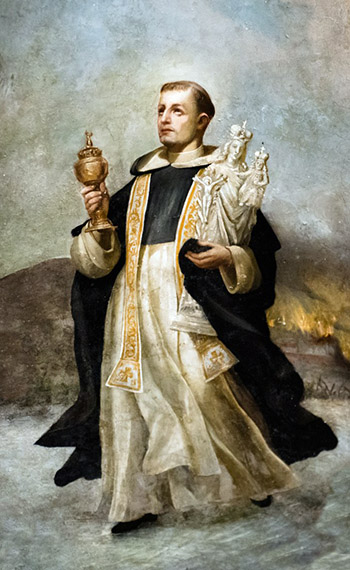 Then, the marvel happens: He and his brothers process through the barbarians who find themselves unable to do anything to stop them. The cortege crosses the city ablaze in flames until they arrive at the Dnieper River, which is a large, fast-flowing river. The waters become solid under their feet. He and his brothers cross the river waters until they reach the far away Krakow. The statue, which became light as a feather during the course, then resumed its natural weight which was too heavy for one man to move it.
This is a good example for the just men during the time of the events predicted by Our Lady of Fatima who are facing the present-day world, which refused her message. For those who remain with the Blessed Sacrament and Our Lady, the flames will not burn them and the barbarians will not kill them; the very water of the river will become solid for them to walk over. Those who must be the seeds of the Reign of Mary will arrive harmless to the other side of the Chastisement.
We can imagine the beauty of the scene of St. Hyacinth arriving in Heaven, preceded by a Choir of Virgins because he was a virgin, followed by a Choir of Angels because he was angelic, a son of that Angelic Doctor who was St, Dominic; with the Canticle of his glory being sung by Our Lady who came herself to escort him. You can imagine what this signifies.
This is what will come for us, if St. Hyacinth prays for us along with our Patron Saints, and if we will be faithful to the Catholic Faith. A moment will come when each one of us will sing this Veni: “Come from Lebanon, my spouse, come from Lebanon, come: thou shalt be crowned …” (Cant 4:8). And then we will enter into the possession of the One who said: “I will be your reward exceeding great” – “Ego ero merces tua magna nimis." (Gen 15:1)

St. Hyacinth (1185-1257) belonged to the Order of the Preachers – the Dominicans. In 1228 he was sent from Rome, where he had received the religious habit of the Order from St. Dominic himself, to establish a monastery in Krakow, Poland. He preached a crusade against the idolater Prussians and died on the feast of the Assumption, August 15, 1257. Our Lady herself came to escort him to Heaven.
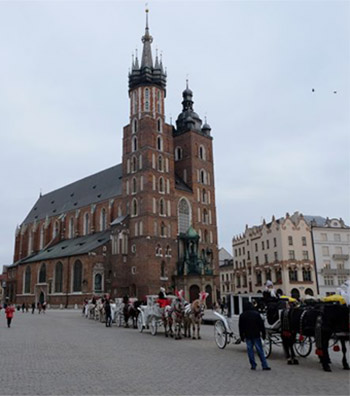
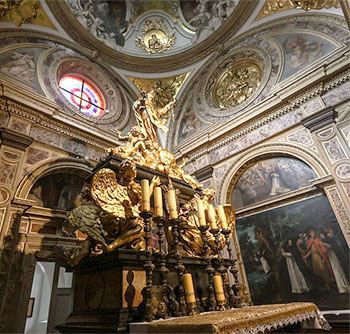
Basilica of the Most Holy Trinity in Krakow, where the tomb & relics of St. Hyacinth, below, rest today
At the beginning of his apostolic life, Our Lady appeared to him on the vigil of the Assumption and said: “My son Hyacinth, have great courage and be joyful. Whatsover you will ask in my name shall be granted to you.” From this happy interview, the Saint gained a total confidence that no difficulty could ever shake. But, above all, he retained from it the virginal fragrance which embalmed his whole life, and the splendor of a supernatural beauty, which made of him an image of his father Dominic.
His existence was interweaved with miraculous intercessions of the Virgin Mary.
Kiev, today Ukraine’s capital, for 50 years had resisted the apostolic zeal of the Saint. The Tartars, as avengers of God’s justice, swept over it and sacked and looted that rebel city.
The devastation reached the very doors of the Sanctuary where Hyacinth was just concluding the Holy Sacrifice. Clothed in his sacred vestments, he took in one hand the Most Holy Sacrament and, in the other, a statue of Our Lady, who asked him to not leave her to the barbarians. Then, together with his brethren, he walked safe and unscathed through the very midst of the bloodthirsty barbarians, along the streets all in flames, and then across the Dnieper River, whose waters became firm under his feet to support his steps.
He continued his miraculous retreat as far as Krakow where he laid down his precious burden in the Monastery of the Most Holy Trinity. The statue of Mary, light as a reed while he was carrying it, now resumed its natural weight, which was so great that one man could not so much as move it.
Comments of Prof. Plinio:
I am not sure if in this short reading you could follow well this marvelous historic event reported by Dom Guéranger.
St. Hyacinth was in an unfaithful city that had resisted the grace. He received the news that the Tartars were devastating the city and would invade the church. He had just finished celebrating Mass and was still wearing his sacred vestments when he took the chalice with the Blessed Sacrament in one hand and, in the other, a heavy statue of Our Lady, who had spoke to him, asking him not to let her fall into barbarian hands.
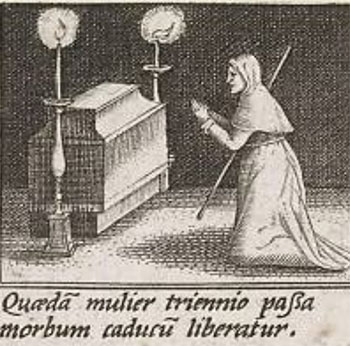
Carrying his treasures, he waslks over the Dnieper River
This is a good example for the just men during the time of the events predicted by Our Lady of Fatima who are facing the present-day world, which refused her message. For those who remain with the Blessed Sacrament and Our Lady, the flames will not burn them and the barbarians will not kill them; the very water of the river will become solid for them to walk over. Those who must be the seeds of the Reign of Mary will arrive harmless to the other side of the Chastisement.
We can imagine the beauty of the scene of St. Hyacinth arriving in Heaven, preceded by a Choir of Virgins because he was a virgin, followed by a Choir of Angels because he was angelic, a son of that Angelic Doctor who was St, Dominic; with the Canticle of his glory being sung by Our Lady who came herself to escort him. You can imagine what this signifies.
This is what will come for us, if St. Hyacinth prays for us along with our Patron Saints, and if we will be faithful to the Catholic Faith. A moment will come when each one of us will sing this Veni: “Come from Lebanon, my spouse, come from Lebanon, come: thou shalt be crowned …” (Cant 4:8). And then we will enter into the possession of the One who said: “I will be your reward exceeding great” – “Ego ero merces tua magna nimis." (Gen 15:1)
His tomb was a popular pilgrimage site in the Middles Ages


  | |
|
|
The texts of both the biographical data and the comments come from personal notes taken by Atila S. Guimarães from 1964 to 1995. Given the fact that the source is a personal notebook, it is possible that at times the biographic notes transcribed here will not rigorously follow the original text read by Prof. Plinio. The commentaries have also been adapted and translated for TIA’s site.