Feasts of Our Lady
 |
 |
 |
 |
 |
 |
 |
St. Anthony Preaching to the Fish
June 13
Although today St. Anthony of Padua has the reputation in Brazil of being the “matchmaking Saint" [and in the United States the Saint who finds lost things], in fact he was a Doctor of the Church, a man of great culture, learning and sanctity; his polemical spirit was such that he was called the “Hammer of Heretics.” That is to say, everything he said was like a hammer blow to the heads of the heretics.
He had a prodigious memory, so strong that he had memorized the entire Scripture and, further, understood it profoundly, quoting profusely from the Old and New Testaments. In his controversies with heretics on the interpretation of the Old and New Testaments, this was of tremendous help to him. He had no need for the electronic brain to remind him of Scripture; he had the supernatural brain for Scripture…
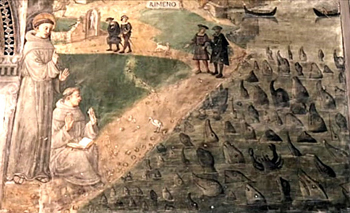 The Little Flowers of St. Francis narrates an episode of his life that gives a lesson on the wonderful hierarchy and great sacrality of the Middle Ages. In this extremely charming miracle, St. Anthony comes to preach to the heretics but they do not want to listen. He then turns to the fish. The fish come and perform a charming miracle, and the city is converted.
Here is the text:
“St. Anthony traveled to Rimini, where a great number of heretics lived. He wished to bring them back to the way of virtue and to the light of the true Faith. He preached to them for many days. He debated with them about the Sacred Scriptures and about their lack of faith in Jesus. But being a stubborn people with hard hearts, they refused to listen.
“So by divine inspiration, St. Anthony walked down to the shore which was battered by the sea. He stood on the shoreline between the sea and the river. And he spoke to the fish like a preacher who was sent by God himself.
 Now comes his sermon to the fish, which is delightful!
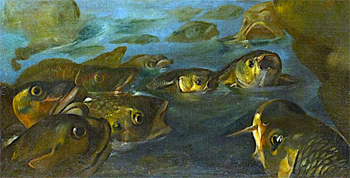
“St. Anthony said, ‘All of you fishes of the sea and the river! Listen to the Word of God, especially since the unbelievers refuse to hear it!’ When he said these words, a vast number of fish swam over to be near him. All of the fish held their heads high above the water. They looked attentively upon the face of the Saint.”
The scene is enchanting! The geographical location is delightful: It is a river that meets the ocean, the estuary where fresh water meets salt water. The people of Rimini undoubtedly were keenly aware of fishing matters, and probably made their living from it to some extent. And here they saw fish appear in unprecedented quantities.
Then, all the fish put their heads out of the water and looked at St. Anthony. Could there be a more curious scene than this: the running waters and the fish all motionless looking at St. Anthony? It is a charming scene and, at the same time, a great miracle. It combines grandeur with charm.
“They came in all shapes and sizes; and they arranged themselves in order. The smallest fish came closest to him. Behind them were the fish of moderate size. And behind them, in the deepest waters, were the largest fish.”
 You see a kind of hierarchy in the world of fish, which corresponds to the hierarchy of medieval society and the hierarchy of the Church and of Heaven. The fish are all ordered, all well arranged …
“St Anthony preached to them with great sincerity: “Brother and sister fishes..”
It was a dramatic moment. In the picture we are looking at the fish, but St. Anthony was looking at the heretics. He did not want the souls of the heretics to be lost. He was preaching with solemnity because it was a great episode in the fight against heresy. He knew that the news of this miracle would spread throughout the whole world.
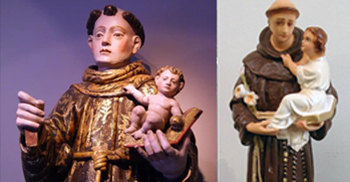
What was St. Anthony like? I saw a fresco from the Giotto school in Padua, which probably best represents St. Anthony: a thick man with a powerful neck and a serious face. Very different from those youthful, rosy-cheeked, unintelligent St. Anthony's statues that you see for sale in religious shops.
You must imagine the great and powerful solemnity of this man – the “Hammer of the heretics” and “Ark of the Covenant” – speaking to the fish; the wind blows and carries his words. Behind him, the heretics look on.
He told the fishes: “You are honor bound to give thanks to the Creator for giving you the sea and the river, such noble dwellings in which to live. God has given you fresh water and salted water. He has given you safe places of refuge in which to escape the tempest. He has given you clear waters through which you can find the food that He has given you to eat, so that you may live. Your Creator was kind and courteous when He made you.”
What a beautiful idea: the fish thanking God for the nobility of the water! What a wonderful presentation of how God acts with fish! If towards fish He is courteous, kind and generous, how much more so is He with man, His children redeemed by His Blood?
“He commanded you to multiply. He gave you His blessing. During the great flood, all other creatures perished, but God save you without injury. God also gave you fins so that you can go wherever you want, so that you can live wherever you wish.”
That is to say, they are the only ones of the antediluvian fauna that do not descend from a single lineage because, during the flood, they continued to rejoice in the immense waters. An ingenious idea that would not occur to anyone! How profound! How much doctrine in these amiable words, how much seriousness behind that affable smile!…
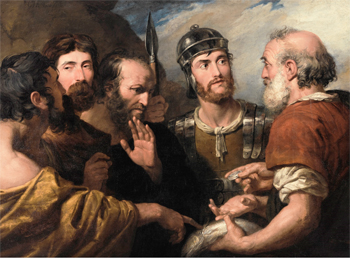 “You offered up the tribute money to the Lord Jesus Christ which He could not pay because He was too poor. And by reason of a divine mystery, you were the food for Christ, our Eternal King, both before and after His Resurrection. For these reasons, you should praise and thank God who has blessed you more than all other creatures.
“At these words and others like them, the fish of the sea and the fish of the river bowed their heads and opened their mouths. Along with other signs of reverence, they gave praise and thanks to God.”
See the tranquility of the scene: As best they could, they praised God. The Catholic spirit is present in this: the spirit of obedience and respect. The fish not only showed signs of joy, but also bowed down to St. Anthony. Since the fish is less than the man, it must bow down to him. The fish were all arranged in a hierarchy of size – from small to large – before the man, who is more than they are, and thus they bowed down.
See how everything is well thought out, how each thing is profound, asks for comment, contains a lesson. How marvelous and gracious it is!
“St. Anthony saw their reverence and rejoiced in spirit. And he cried out: ‘Blessed be the Eternal God because the fishes of these waters honor Him more than the unbelieving heretics! These mere creatures, born without reason, hear God’s Word more willingly than these unbelieving people!’”
You see the irony: The infidels are less than the animals. To say this normally would be a rude insult. But here, the insult comes with elevation and falls perpendicularly. How shameful that everyone accepts what the Saint says but the heretics refuse it! It is a great act of pulverizing the adversary with a smile, candor and kindness. It is a way of fighting and winning…
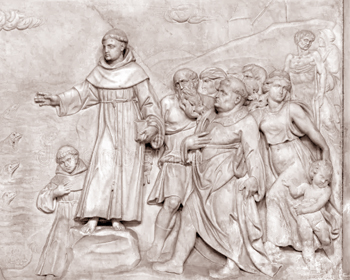 “The longer St. Anthony preached, the larger the multitude of fishes grew. Not a single fish left that place while St. Anthony spoke to them. When they heard about this unfolding miracle, the people of the city ran toward the shore. When they saw the miracle for themselves, their hard hearts were pierced. They drew close to St. Anthony, cast themselves at his feet, and listened closely to his words.”
You see that he spoke to the fish, but he did so for men to hear.
“St. Anthony then began to preach about the Catholic Faith, and preached so nobly that he converted all those heretics and made them return to the Catholic Faith. And all the faithful were filled with great joy and comforted in their faith. And having done this, St. Anthony sent the fish away, with God’s blessing.”
How beautiful! Now it is finished, with a blessing for the fish! They were dismissed. The animal was made to serve man. Now they are no longer needed, they are gone. No fish were caught, none were killed, there was amiability in everything. They returned to their waters in peace, and the heretics were humbled.
So, the end of this interplay between man and the fishes is the people leaving, saying,“ Look at that Saint! See what a great teacher he is! ” and the fish disperse…
You can imagine St. Anthony standing alone on the beach praying and thinking about the greatness of God, and praising Our Lady.The end is stirring: the Saint praying alone, the grand holy silence; no one dares draw near.
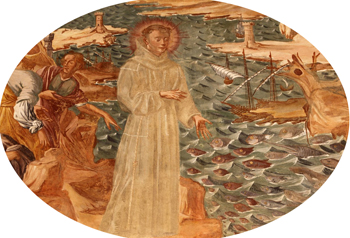 Night falls, he returns to the monastery. It was a full day, the heretics were destroyed! A great victory, a river and sea victory of the Holy Catholic, Apostolic, Roman Church!
“And then St. Anthony remained in the city for many more days, preaching and gathering a great harvest of souls for the Lord.” And it ends like this: “Praise be Christ, Amen.”
Hearing the story is a blessing for us, who will scatter like the fish. Let us imitate their example and stay here praising St. Anthony and understanding the marvelous soul of the Middle Ages. And let us ask Our Lady to give us this marvelous spirit, which was not intrinsic to the Middle Ages: It was intrinsic to the Catholic Church, or rather, it is intrinsic to the Catholic Church because the Church does not change. And the Middle Ages had it because it was Catholic.
When men have the ardent faith that the medieval man had – and one even more ardent – then we will see even greater wonders!

St. Anthony of Padua – June 13
The Militancy of St. Anthony of Padua

The Saint of the Day features highlights from the lives of saints based on comments made by the late Prof. Plinio Corrêa de Oliveira. Following the example of St. John Bosco who used to make similar talks for the boys of his College, each evening it was Prof. Plinio’s custom to make a short commentary on the lives of the next day’s saint in a meeting for youth in order to encourage them in the practice of virtue and love for the Catholic Church. TIA thought that its readers could profit from these valuable commentaries.
The texts of both the biographical data and the comments come from personal notes taken by Atila S. Guimarães from 1964 to 1995. Given the fact that the source is a personal notebook, it is possible that at times the biographic notes transcribed here will not rigorously follow the original text read by Prof. Plinio. The commentaries have also been adapted and translated for TIA’s site.
He had a prodigious memory, so strong that he had memorized the entire Scripture and, further, understood it profoundly, quoting profusely from the Old and New Testaments. In his controversies with heretics on the interpretation of the Old and New Testaments, this was of tremendous help to him. He had no need for the electronic brain to remind him of Scripture; he had the supernatural brain for Scripture…
A charming episode of St. Anthony
preaching to the fishes in Rimini
Here is the text:
“St. Anthony traveled to Rimini, where a great number of heretics lived. He wished to bring them back to the way of virtue and to the light of the true Faith. He preached to them for many days. He debated with them about the Sacred Scriptures and about their lack of faith in Jesus. But being a stubborn people with hard hearts, they refused to listen.
“So by divine inspiration, St. Anthony walked down to the shore which was battered by the sea. He stood on the shoreline between the sea and the river. And he spoke to the fish like a preacher who was sent by God himself.
The fish line up by size and listen with open mouths,
taking in the words of the Saint
“St. Anthony said, ‘All of you fishes of the sea and the river! Listen to the Word of God, especially since the unbelievers refuse to hear it!’ When he said these words, a vast number of fish swam over to be near him. All of the fish held their heads high above the water. They looked attentively upon the face of the Saint.”
The scene is enchanting! The geographical location is delightful: It is a river that meets the ocean, the estuary where fresh water meets salt water. The people of Rimini undoubtedly were keenly aware of fishing matters, and probably made their living from it to some extent. And here they saw fish appear in unprecedented quantities.
Then, all the fish put their heads out of the water and looked at St. Anthony. Could there be a more curious scene than this: the running waters and the fish all motionless looking at St. Anthony? It is a charming scene and, at the same time, a great miracle. It combines grandeur with charm.
“They came in all shapes and sizes; and they arranged themselves in order. The smallest fish came closest to him. Behind them were the fish of moderate size. And behind them, in the deepest waters, were the largest fish.”
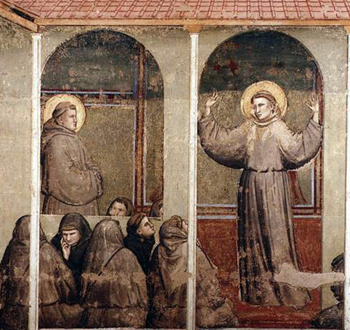
A serious St. Anthony; at right, a sentimental statue; below left, St. Anthony with St. Francis at Arles
“St Anthony preached to them with great sincerity: “Brother and sister fishes..”
It was a dramatic moment. In the picture we are looking at the fish, but St. Anthony was looking at the heretics. He did not want the souls of the heretics to be lost. He was preaching with solemnity because it was a great episode in the fight against heresy. He knew that the news of this miracle would spread throughout the whole world.
What was St. Anthony like? I saw a fresco from the Giotto school in Padua, which probably best represents St. Anthony: a thick man with a powerful neck and a serious face. Very different from those youthful, rosy-cheeked, unintelligent St. Anthony's statues that you see for sale in religious shops.
You must imagine the great and powerful solemnity of this man – the “Hammer of the heretics” and “Ark of the Covenant” – speaking to the fish; the wind blows and carries his words. Behind him, the heretics look on.
He told the fishes: “You are honor bound to give thanks to the Creator for giving you the sea and the river, such noble dwellings in which to live. God has given you fresh water and salted water. He has given you safe places of refuge in which to escape the tempest. He has given you clear waters through which you can find the food that He has given you to eat, so that you may live. Your Creator was kind and courteous when He made you.”
What a beautiful idea: the fish thanking God for the nobility of the water! What a wonderful presentation of how God acts with fish! If towards fish He is courteous, kind and generous, how much more so is He with man, His children redeemed by His Blood?
“He commanded you to multiply. He gave you His blessing. During the great flood, all other creatures perished, but God save you without injury. God also gave you fins so that you can go wherever you want, so that you can live wherever you wish.”
That is to say, they are the only ones of the antediluvian fauna that do not descend from a single lineage because, during the flood, they continued to rejoice in the immense waters. An ingenious idea that would not occur to anyone! How profound! How much doctrine in these amiable words, how much seriousness behind that affable smile!…
St. Peter paying the tribute with a coin found in a fish
“At these words and others like them, the fish of the sea and the fish of the river bowed their heads and opened their mouths. Along with other signs of reverence, they gave praise and thanks to God.”
See the tranquility of the scene: As best they could, they praised God. The Catholic spirit is present in this: the spirit of obedience and respect. The fish not only showed signs of joy, but also bowed down to St. Anthony. Since the fish is less than the man, it must bow down to him. The fish were all arranged in a hierarchy of size – from small to large – before the man, who is more than they are, and thus they bowed down.
See how everything is well thought out, how each thing is profound, asks for comment, contains a lesson. How marvelous and gracious it is!
“St. Anthony saw their reverence and rejoiced in spirit. And he cried out: ‘Blessed be the Eternal God because the fishes of these waters honor Him more than the unbelieving heretics! These mere creatures, born without reason, hear God’s Word more willingly than these unbelieving people!’”
You see the irony: The infidels are less than the animals. To say this normally would be a rude insult. But here, the insult comes with elevation and falls perpendicularly. How shameful that everyone accepts what the Saint says but the heretics refuse it! It is a great act of pulverizing the adversary with a smile, candor and kindness. It is a way of fighting and winning…
The heretics, who refused the words of the Staint,
were astounded
You see that he spoke to the fish, but he did so for men to hear.
“St. Anthony then began to preach about the Catholic Faith, and preached so nobly that he converted all those heretics and made them return to the Catholic Faith. And all the faithful were filled with great joy and comforted in their faith. And having done this, St. Anthony sent the fish away, with God’s blessing.”
How beautiful! Now it is finished, with a blessing for the fish! They were dismissed. The animal was made to serve man. Now they are no longer needed, they are gone. No fish were caught, none were killed, there was amiability in everything. They returned to their waters in peace, and the heretics were humbled.
So, the end of this interplay between man and the fishes is the people leaving, saying,“ Look at that Saint! See what a great teacher he is! ” and the fish disperse…
You can imagine St. Anthony standing alone on the beach praying and thinking about the greatness of God, and praising Our Lady.The end is stirring: the Saint praying alone, the grand holy silence; no one dares draw near.
A charming episode where St. Anthony
destroyed the heretics
“And then St. Anthony remained in the city for many more days, preaching and gathering a great harvest of souls for the Lord.” And it ends like this: “Praise be Christ, Amen.”
Hearing the story is a blessing for us, who will scatter like the fish. Let us imitate their example and stay here praising St. Anthony and understanding the marvelous soul of the Middle Ages. And let us ask Our Lady to give us this marvelous spirit, which was not intrinsic to the Middle Ages: It was intrinsic to the Catholic Church, or rather, it is intrinsic to the Catholic Church because the Church does not change. And the Middle Ages had it because it was Catholic.
When men have the ardent faith that the medieval man had – and one even more ardent – then we will see even greater wonders!
The Militancy of St. Anthony of Padua


  | |
|
|
The texts of both the biographical data and the comments come from personal notes taken by Atila S. Guimarães from 1964 to 1995. Given the fact that the source is a personal notebook, it is possible that at times the biographic notes transcribed here will not rigorously follow the original text read by Prof. Plinio. The commentaries have also been adapted and translated for TIA’s site.