Documents for your files
 |
PROGRESSIVIST DOCUMENTS
'Conciliar Church,'
an Expression Created by Paul VI
an Expression Created by Paul VI
Tradition in Action habitually uses the expression "Conciliar Church" when referring to the ensemble of changes made in the Catholic Church in the post-Vatican II period. Given the extent of the reforms in every single field of our Holy Religion, the recent ecclesiastical establishment looks very much like a New Church molded by the Council..
Radical progressivists are proud to affirm that they have changed or are changing the Catholic Church into something very different, as we have documented exhaustively in this section Progressivist Documents. For instance, here, here, here, here, here, here, here, here, here, here, here and here.
The middle-of-the-road and "conservative" progressivists, however, struggle to present the post-Vatican II Church as a justifiable continuation of the Catholic Church. Doing so, they prevent Catholics from reacting against those changes, which would lead to a paralysis of the process. Therefore, those "moderate" and "conservative" progressivists are agents to keep that healthy reaction anesthetized.
Since a growing number of Catholics are indignant over those changes, the "moderates" and "conservatives" want to stop TIA from pointing out the gap between the two Churches. For this reason they attack us.
Recently these persons – including Internet active priests – are accusing us of being "heretical" and "Gnostic" for using the expression "Conciliar Church."
Regardless of their poor arguments, it is ironic because the first person to employ this expression referring to the Vatican II reforms was no other than Paul VI himself, their great architect. So, by providing evidence that it was Paul VI who invented the expression Conciliar Church and made it circulate, the foolish ignorance and grim malice of our accusers are exposed. Further, their imputations boomerang back against their idol, Paul VI...
Below, we present three instances in which Paul VI used the expression "Conciliar Church" referring to the Church after the changes made by the Second Vatican Council.
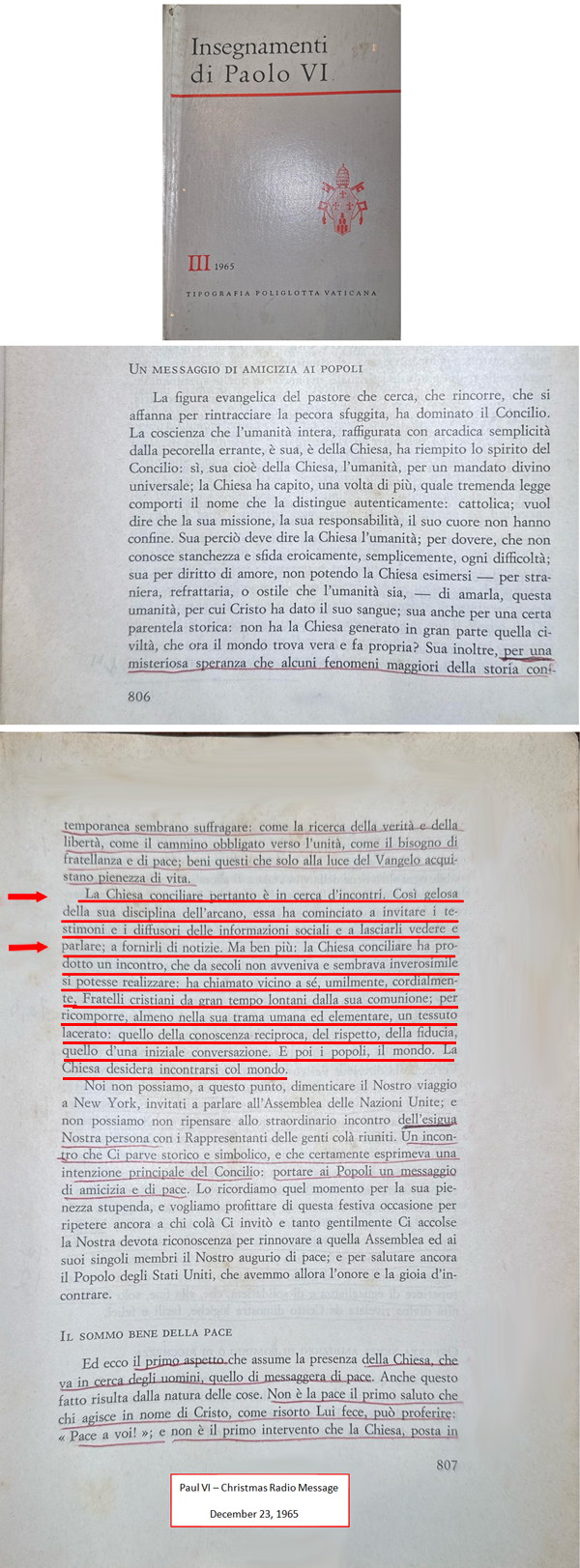
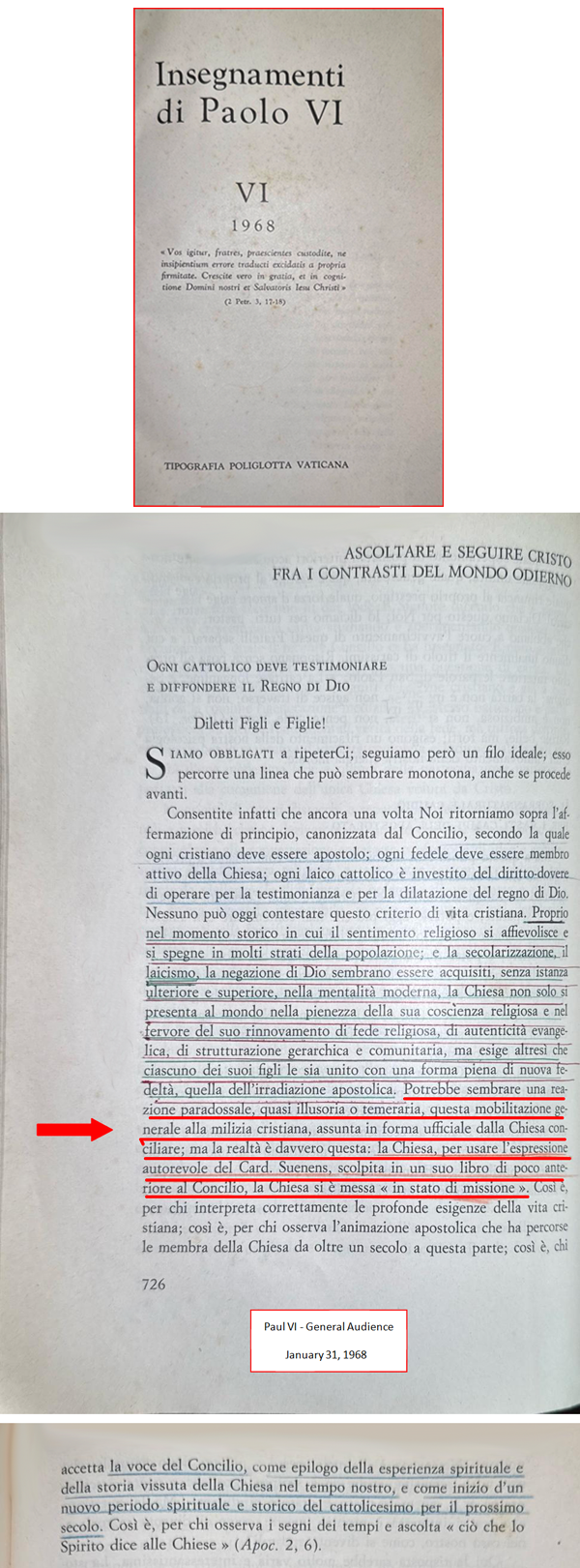
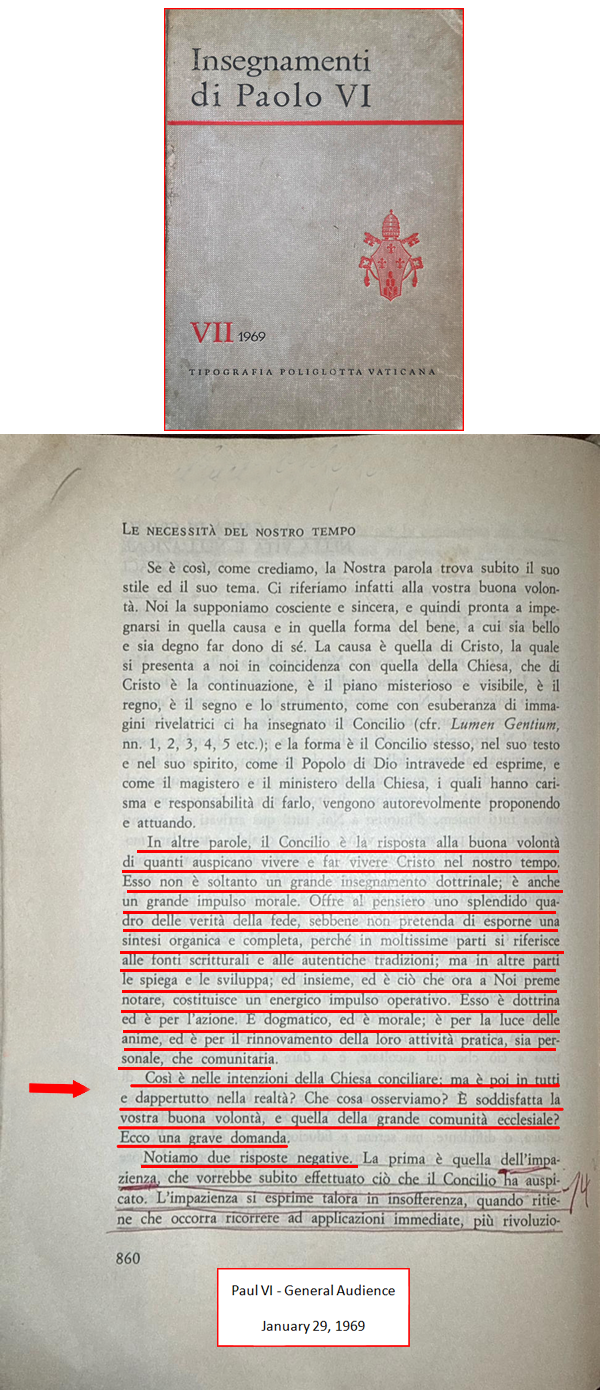
We are posting photocopies of the official Vatican documents taken from Insegnamenti di Paolo VI published by the Tipografia Poliglotta Vaticana, followed by our translation from the Italian into English. The parts relevant to our topic are marked with bright red underlining. The texts where the Pope uses that expression are indicated by an arrow.
Radical progressivists are proud to affirm that they have changed or are changing the Catholic Church into something very different, as we have documented exhaustively in this section Progressivist Documents. For instance, here, here, here, here, here, here, here, here, here, here, here and here.
The middle-of-the-road and "conservative" progressivists, however, struggle to present the post-Vatican II Church as a justifiable continuation of the Catholic Church. Doing so, they prevent Catholics from reacting against those changes, which would lead to a paralysis of the process. Therefore, those "moderate" and "conservative" progressivists are agents to keep that healthy reaction anesthetized.
Since a growing number of Catholics are indignant over those changes, the "moderates" and "conservatives" want to stop TIA from pointing out the gap between the two Churches. For this reason they attack us.
Recently these persons – including Internet active priests – are accusing us of being "heretical" and "Gnostic" for using the expression "Conciliar Church."
Regardless of their poor arguments, it is ironic because the first person to employ this expression referring to the Vatican II reforms was no other than Paul VI himself, their great architect. So, by providing evidence that it was Paul VI who invented the expression Conciliar Church and made it circulate, the foolish ignorance and grim malice of our accusers are exposed. Further, their imputations boomerang back against their idol, Paul VI...
Below, we present three instances in which Paul VI used the expression "Conciliar Church" referring to the Church after the changes made by the Second Vatican Council.
We are posting photocopies of the official Vatican documents taken from Insegnamenti di Paolo VI published by the Tipografia Poliglotta Vaticana, followed by our translation from the Italian into English. The parts relevant to our topic are marked with bright red underlining. The texts where the Pope uses that expression are indicated by an arrow.
Paul VI - Christmas Radio Message of December 23, 1965
The Conciliar Church, therefore, is looking for encounters. Very zealous of its discipline of the arcane, it started to invite the witnesses and disseminators of social information and to let them see and speak; to release the news.
But much more: The Conciliar Church has produced an encounter, which has not happened for centuries and that seemed implausible to be realized. Humbly and cordially, it has called Christian Brothers close to it who have long been far from its communion, in order to repair, at least in its human and elementary weaving, a torn tissue: that of reciprocal knowledge, respect, confidence, an initial conversation.
And after that, the peoples, the world. The Church desires to meet with the world.
The Conciliar Church, therefore, is looking for encounters. Very zealous of its discipline of the arcane, it started to invite the witnesses and disseminators of social information and to let them see and speak; to release the news.
But much more: The Conciliar Church has produced an encounter, which has not happened for centuries and that seemed implausible to be realized. Humbly and cordially, it has called Christian Brothers close to it who have long been far from its communion, in order to repair, at least in its human and elementary weaving, a torn tissue: that of reciprocal knowledge, respect, confidence, an initial conversation.
And after that, the peoples, the world. The Church desires to meet with the world.
Paul VI - General Audience of January 31, 1968
It could appear to be a paradoxical reaction, almost illusory or imprudent, this general mobilization of the Christian militia, officially made by the Conciliar Church. But the reality is indeed this: The Church, to use the authoritative expression of Cardinal Suenens, forged in a book by himself issued a little before the Council, the Church has put itself "into a state of mission."
It could appear to be a paradoxical reaction, almost illusory or imprudent, this general mobilization of the Christian militia, officially made by the Conciliar Church. But the reality is indeed this: The Church, to use the authoritative expression of Cardinal Suenens, forged in a book by himself issued a little before the Council, the Church has put itself "into a state of mission."
Paul VI - General Audience of January 29, 1969
In other words, the Council is the answer to the good will of all those who wish to live and make Christ live in our time. It is not only a great doctrinal teaching; it is also a great moral impulse. It offers to thinking a great picture of the truths of the faith, although it does not pretend to present a complete organic synthesis, because in a great many parts it refers to Scriptural sources and authentic traditions. But in other parts, it explains and develops them. Altogether, and this is what is important for us to note, it constitutes an energetic operative impulse. It is doctrine and it is turned toward action. It is dogmatic and moral; it is turned toward the light of souls and toward a renewal of a practical activity both personal and communitarian.
This are the intentions of the Conciliar Church. But what is the reality in the minds of everyone everywhere? What do we observe? Does this satisfy your good will and that of the great ecclesial community? Behold a grave question.
We note two negative answers.
In other words, the Council is the answer to the good will of all those who wish to live and make Christ live in our time. It is not only a great doctrinal teaching; it is also a great moral impulse. It offers to thinking a great picture of the truths of the faith, although it does not pretend to present a complete organic synthesis, because in a great many parts it refers to Scriptural sources and authentic traditions. But in other parts, it explains and develops them. Altogether, and this is what is important for us to note, it constitutes an energetic operative impulse. It is doctrine and it is turned toward action. It is dogmatic and moral; it is turned toward the light of souls and toward a renewal of a practical activity both personal and communitarian.
This are the intentions of the Conciliar Church. But what is the reality in the minds of everyone everywhere? What do we observe? Does this satisfy your good will and that of the great ecclesial community? Behold a grave question.
We note two negative answers.
Posted on October 10, 2026



______________________
______________________
 Volume I |
 Volume II |
 Volume III |
 Volume IV |
 Volume V |
 Volume VI |
 Volume VII |
 Volume VIII |
 Volume IX |
 Volume X |
 Volume XI |
 Special Edition |