New Canonizations
 |
 |
 |
 |
 |
 |
 |
Fulton Sheen’s Bad Doctrine & Morals
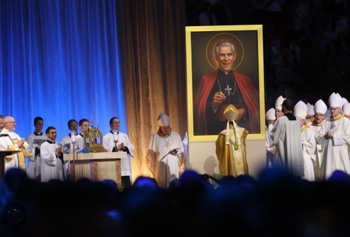
Last week, on September 24, 2026, the beatification Mass of Bishop Fulton Sheen, presided over by Card. Tagle, took place in one of the cultural capitals of the American heartland, St. Louis, Missouri.
 Readying for Sheen’s beatification, conservative Novus Ordo groups are all
rushing to show their
connections to Sheen. Card. Burke, symbol of the “conservative” wing of Progressivism, stated in a recent nterview: “I’m so happy, finally, that he will be beatified.”
Readying for Sheen’s beatification, conservative Novus Ordo groups are all
rushing to show their
connections to Sheen. Card. Burke, symbol of the “conservative” wing of Progressivism, stated in a recent nterview: “I’m so happy, finally, that he will be beatified.”
Even those who call themselves traditionalists are attempting to whitewash Fulton Sheen: Michael Matt insists he was a well-meaning “good bishop” who just never lived to see the Revolution. Mel Gibson, a sede-vacantist who in theory is opposed to Progressivism, praised Sheen and even counseled Catholics to ask for his intercession.
So, what are counter-revolutionary Catholics to think about Sheen? Who was he really? Why is he being praised and held up as a model ideal by progressivists, and even some conservatives and traditionalists?
TIA has been consistently answered these questions and others about Sheen for 16 years - since 2010 - in 12 different articles. Allow me to summarize these articles, reminding readers of Fulton Sheen’s bad doctrines and morals, which demonstrate clearly that he was not the “conservative” Bishop the Conciliar Church makes him out to be, but rather a radical progressivist wolf in sheep’s clothing.
A chameleon
A first question that must be answered: Why was Fulton Sheen so popular? Like the Council documents, he was skilled in ambiguity: He would make radical progressivist statements and doctrines sound conservative. Like Pope Leo XIV, his mission was one of synthesis: to bring together traditionalists and progressivists in the via media (the middle road). This is why he was popular: because he knew how to please everyone, including enemies of the Church.
Sheen & Vatican II
 Sheen was an advocate of Vatican II, its latent Progressivism and its noxious reforms. In his autobiography, Treasure in Clay, Sheen called Gaudium et Spes “a master stroke under the inspiration of the Holy Spirit,” and stated that his attendance at Vatican II was “one of the great blessings the Lord bestowed on my life.” (p. 281) His Diocesan paper of Rochester, the Catholic Courier Journal (CCJ), reported his aims to make Rochester “a model Diocese styled and moved by the spirit of Vatican II Council.” He even
called any resistance to Vatican II "demonic.”
Sheen was an advocate of Vatican II, its latent Progressivism and its noxious reforms. In his autobiography, Treasure in Clay, Sheen called Gaudium et Spes “a master stroke under the inspiration of the Holy Spirit,” and stated that his attendance at Vatican II was “one of the great blessings the Lord bestowed on my life.” (p. 281) His Diocesan paper of Rochester, the Catholic Courier Journal (CCJ), reported his aims to make Rochester “a model Diocese styled and moved by the spirit of Vatican II Council.” He even
called any resistance to Vatican II "demonic.”
It is hard to understand how anyone could consider Sheen a good Bishop, considering that he praised the one landmark event that institutionalized Progressivism in the Church and has been the cause of the destruction of her institutions, doctrines, liturgy and morals.
Promoting co-education & dismantling hierarchy
Speaking of destruction of institutions, Sheen himself was not somehow unaware of the progressivist reforms, just a guiltless spectator, as some trads are suggesting. He was a pioneer in progressivist reforms in Rochester, NY, making drastic changes at the institutional level that many of his parishioners were not prepared for. He considered Rochester his experimentation ground for the most radical progressivist initiatives, all inspired by Vatican II.
One case was Sheen’s push for co-education. The CCJ reported Sheen’s startling initiative to turn Rochester’s St. Andrew’s Preparatory School, which was an all-boys high school turned toward forming future priests, into the co-educational “King’s Preparatory” school, so that “Christian leaders” (ambiguity again with the word “Christian”) could be formed by “rising above dull conventionality.” So, the Church’s traditional and wise custom of making all-boys or all-girls schools – as well as its previous condemnations of co-education – was pejoratively called by Sheen “dull conventionality.”
Other institutional firsts of Sheen inspired by Vatican II that TIA reported:
Some have pointed out that Sheen spoke against Communism. Again, this topic is no exception to Sheen’s ambiguity: While he spoke against Communism, at the same time he pushed for self-management and co-ownership, which are the stated final ends of Communism and were condemned by Pope Pius XII. Indeed, Sheen stated:
 “There ought to be incorporate some form of co-ownership in which a worker would receive some part of the profits which he has helped to produce. Certainly, the man who gave money and who clipped coupons is entitled to his, but the worker also is entitled to some share in that wealth. It need not be given in the form of stock alone. At any rate,
some form of co-management, some form of co-ownership, in which the bond will deepen between himself and the industry where he works … No one class is entitled to take all of the profits!"
“There ought to be incorporate some form of co-ownership in which a worker would receive some part of the profits which he has helped to produce. Certainly, the man who gave money and who clipped coupons is entitled to his, but the worker also is entitled to some share in that wealth. It need not be given in the form of stock alone. At any rate,
some form of co-management, some form of co-ownership, in which the bond will deepen between himself and the industry where he works … No one class is entitled to take all of the profits!"
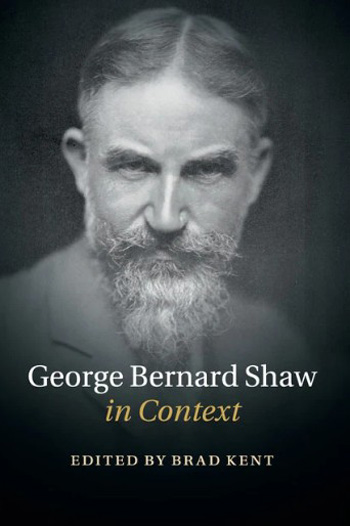
This is why Fulton Sheen was a favorite among distributists, who, as an aside, actually promote more radical aims (equal means of production) than regular Socialism (equal fruits of production), according to distributist Fr. Patrick Cahill and known English socialist George Bernard Shaw.
Besides pushing for self-management and co-ownership, Sheen gave a leadership role to a priest who was a close associate of Saul Alinsky, the famous communist agitator. This priest, with the blessing of Sheen, proceeded to make racial class struggle with the FIGHT movement in Rochester as a false solution to a real problem. TIA pointed out: “Instead of condemning the openly communist social agitator Saul Alinsky, he paid an indirect tribute to him and his work.”
So although Sheen attacked Communism with words, he directly or indirectly promoted communist principles and its most radical proponents.
Ecumenism
Perhaps the worst aspect of Sheen was his commitment to pandering to false religions, particularly Protestantism and Judaism.
One case was St. Bernard Seminary. The CCJ reported his initiative to turn that seminary for priests into an ecumenical seminary, taught by Catholic and Protestants (Baptist and Episcopal), and with Catholic seminarians learning alongside Protestant fellow students. Sheen’s words:
“Because other religious seminaries have recognized the double mission of being a servant and needing a Savior, the time has come to join with them in those things where we can help one another and save the world.”
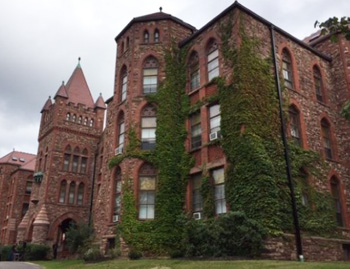 That ecumenical seminary never came to life, despite his assiduous plans, because it was not well-received by the Catholics in his Diocese.
This was not Sheen’s only instance of pandering to Protestants. During his time in Rochester, on September 13, 1968, he invited a Protestant pastor to speak from the pulpit at Sacred Heart Cathedral at all six Sunday masses. Only four months later in January 1969, Bishop Sheen himself spoke at the Sunday ecumenical ‘service’ in the Third Presbyterian Church before an audience of 1,000.
TIA reported on his other ecumenical “firsts” in this first two years of his Rochester Diocese: Sheen addressed an evening Lenten service in Asbury First Methodist Church, spoke at a Lutheran Synod meeting in the Reformation Lutheran church, and gave a talk in Bethany Presbyterian Church on a Sunday afternoon. He also gave the final blessing at an ecumenical service in Christ Episcopal Church cathedral.
Another case of Sheen’s ecumenism was his visit to the synagogue: At the end of January 1967, he visited Rochester’s Jewish synagogue, Temple B’rth Kodesh, and gave a speech there. He even donned the Jewish yarmulke skull cap.
TIA reported that Bishop Sheen entered the synagogue “for the first time in his life,” as the paper (CCJ) reports, “to praise the Jewish people for their works of mercy for the poor” and to assure them that “the God of Abraham, Isaac and Jacob was also the God of the Christians” who is willing to be a Father to every man “no matter how weak he is.”
That is, Sheen blatantly disregarded the First Commandment by suggesting that Jews worship the same God as Catholics, contrary to the teaching of the Church.
Proud of not trying to convert others
Sheen was well-known on TV and radio. One would naturally think he would use his broad influence to convert those in false religions, correct?
Wrong again. As TIA’s Mr. Patrick Odou pointed out:
“The heresy of universal salvation was also latent in his mind as he affirmed: ‘The good Hindu, the good Buddhist, the good Confucianist, the good Moslem are all saved by Christ and not by Buddhism or Islam or Confucianism but through their sacraments, their prayers, their asceticism, their morality, their good life.’ (Treasure in Clay, p.148)
“He was so convinced that everyone could be saved in his own religion that he never used his shows to convert people. Even though he spent hundreds of hours on television, this Prince of the Church, whose mission should be to bring souls to Our Lord and into His flock, stated without remorse that on his television show ‘never once was there an attempt at what might be called proselytizing.’” (Ibid. p. 73)
Sheen’s attitude toward those in false religions completely contradicts the Church’s missionary character, and her call to make “disciples of all nations,” Our Lord’s command written in the Acts of the Apostles.
Bad doctrine
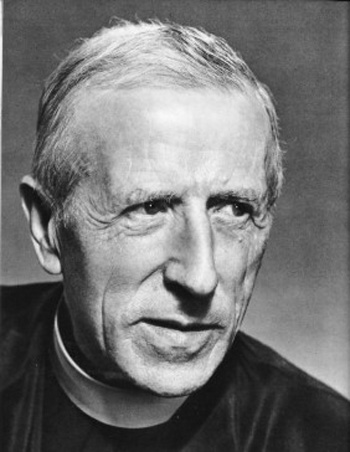 It may come as a surprise to some that Sheen praised Teilhard de Chardin, the progressivist whose writings were full of Pantheism and
were condemned by the Holy Office.
It may come as a surprise to some that Sheen praised Teilhard de Chardin, the progressivist whose writings were full of Pantheism and
were condemned by the Holy Office.
Sheen’s glowing words for Chardin in his book, Footprints in a Darkened Forest, were these:
“It is very likely that within 50 years when all the trivial, verbose disputes about the meaning of Teilhard's ‘unfortunate’ vocabulary will have died away or have taken a secondary place, Teilhard will appear like John of the Cross and St. Teresa of Avila, as the spiritual genius of the twentieth century.”
Bad Morals
Was Sheen spotless in morals? The answer is no, again. His views on sexuality and marriage helped to pave the way for Pope John Paul II’s filthy Theology of the Body. His book, Three to Get Married, introduces the topic of marriage by obsessively dwelling on “sex,” wandering poetically on Freud (p. 3) and the “libido,” (p. 14) the “vital energies” (p. 11) and the “object-subject” theme (p. 11) so prevalent in the Theology of the Body.
Conclusion: not a Saint
In summary, Fulton Sheen is neither a Saint, nor is he a model for Catholics – he was a progressivist. He praised Vatican II and ardently sought to implement its reforms, dismantled long-standing institutions, encouraged liberal customs that would lead to immorality in the clergy, promoted egalitarianism, communist self-management and co-ownership, gave public scandal by praising and participating in worship services of false religions, boasted about not “proselytizing,” promoted the Pantheism of Teilhard de Chardin, and encouraged bad morals and Freudian sex obsession.
Posted September 30, 2026

September 24, the beatification Mass of Fulton Sheen
Even those who call themselves traditionalists are attempting to whitewash Fulton Sheen: Michael Matt insists he was a well-meaning “good bishop” who just never lived to see the Revolution. Mel Gibson, a sede-vacantist who in theory is opposed to Progressivism, praised Sheen and even counseled Catholics to ask for his intercession.
So, what are counter-revolutionary Catholics to think about Sheen? Who was he really? Why is he being praised and held up as a model ideal by progressivists, and even some conservatives and traditionalists?
TIA has been consistently answered these questions and others about Sheen for 16 years - since 2010 - in 12 different articles. Allow me to summarize these articles, reminding readers of Fulton Sheen’s bad doctrines and morals, which demonstrate clearly that he was not the “conservative” Bishop the Conciliar Church makes him out to be, but rather a radical progressivist wolf in sheep’s clothing.
A chameleon
A first question that must be answered: Why was Fulton Sheen so popular? Like the Council documents, he was skilled in ambiguity: He would make radical progressivist statements and doctrines sound conservative. Like Pope Leo XIV, his mission was one of synthesis: to bring together traditionalists and progressivists in the via media (the middle road). This is why he was popular: because he knew how to please everyone, including enemies of the Church.
Sheen & Vatican II
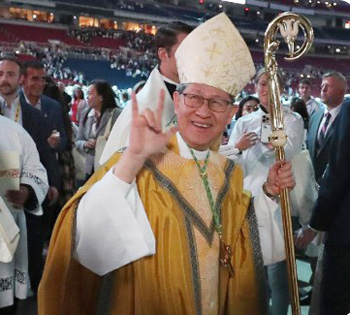
Card. Tagle making the suspicious ‘I love you’ signal
It is hard to understand how anyone could consider Sheen a good Bishop, considering that he praised the one landmark event that institutionalized Progressivism in the Church and has been the cause of the destruction of her institutions, doctrines, liturgy and morals.
Promoting co-education & dismantling hierarchy
Speaking of destruction of institutions, Sheen himself was not somehow unaware of the progressivist reforms, just a guiltless spectator, as some trads are suggesting. He was a pioneer in progressivist reforms in Rochester, NY, making drastic changes at the institutional level that many of his parishioners were not prepared for. He considered Rochester his experimentation ground for the most radical progressivist initiatives, all inspired by Vatican II.
One case was Sheen’s push for co-education. The CCJ reported Sheen’s startling initiative to turn Rochester’s St. Andrew’s Preparatory School, which was an all-boys high school turned toward forming future priests, into the co-educational “King’s Preparatory” school, so that “Christian leaders” (ambiguity again with the word “Christian”) could be formed by “rising above dull conventionality.” So, the Church’s traditional and wise custom of making all-boys or all-girls schools – as well as its previous condemnations of co-education – was pejoratively called by Sheen “dull conventionality.”
Other institutional firsts of Sheen inspired by Vatican II that TIA reported:
- He introduced a social outreach program for seminarians that did away with the previous custom of having seminarians stay in an enclosed grounds;
- He announced the establishment of one of the first Priests’ Councils;
- His Diocese was among the first to raise the age of Confirmation from 10-11 to “later adolescence”;
- He also attempted to make an ecumenical seminary, a fact which I will explain later in this article.
Some have pointed out that Sheen spoke against Communism. Again, this topic is no exception to Sheen’s ambiguity: While he spoke against Communism, at the same time he pushed for self-management and co-ownership, which are the stated final ends of Communism and were condemned by Pope Pius XII. Indeed, Sheen stated:
Sheen’s ideas of co-ownwership were more radical than those of socialist Bernard Shaw
This is why Fulton Sheen was a favorite among distributists, who, as an aside, actually promote more radical aims (equal means of production) than regular Socialism (equal fruits of production), according to distributist Fr. Patrick Cahill and known English socialist George Bernard Shaw.
Besides pushing for self-management and co-ownership, Sheen gave a leadership role to a priest who was a close associate of Saul Alinsky, the famous communist agitator. This priest, with the blessing of Sheen, proceeded to make racial class struggle with the FIGHT movement in Rochester as a false solution to a real problem. TIA pointed out: “Instead of condemning the openly communist social agitator Saul Alinsky, he paid an indirect tribute to him and his work.”
So although Sheen attacked Communism with words, he directly or indirectly promoted communist principles and its most radical proponents.
Ecumenism
Perhaps the worst aspect of Sheen was his commitment to pandering to false religions, particularly Protestantism and Judaism.
One case was St. Bernard Seminary. The CCJ reported his initiative to turn that seminary for priests into an ecumenical seminary, taught by Catholic and Protestants (Baptist and Episcopal), and with Catholic seminarians learning alongside Protestant fellow students. Sheen’s words:
“Because other religious seminaries have recognized the double mission of being a servant and needing a Savior, the time has come to join with them in those things where we can help one another and save the world.”
Sheen tried to make St. Bernard Seminary in Rochester a teaching place for Protestants & Catholics
This was not Sheen’s only instance of pandering to Protestants. During his time in Rochester, on September 13, 1968, he invited a Protestant pastor to speak from the pulpit at Sacred Heart Cathedral at all six Sunday masses. Only four months later in January 1969, Bishop Sheen himself spoke at the Sunday ecumenical ‘service’ in the Third Presbyterian Church before an audience of 1,000.
TIA reported on his other ecumenical “firsts” in this first two years of his Rochester Diocese: Sheen addressed an evening Lenten service in Asbury First Methodist Church, spoke at a Lutheran Synod meeting in the Reformation Lutheran church, and gave a talk in Bethany Presbyterian Church on a Sunday afternoon. He also gave the final blessing at an ecumenical service in Christ Episcopal Church cathedral.
Another case of Sheen’s ecumenism was his visit to the synagogue: At the end of January 1967, he visited Rochester’s Jewish synagogue, Temple B’rth Kodesh, and gave a speech there. He even donned the Jewish yarmulke skull cap.
TIA reported that Bishop Sheen entered the synagogue “for the first time in his life,” as the paper (CCJ) reports, “to praise the Jewish people for their works of mercy for the poor” and to assure them that “the God of Abraham, Isaac and Jacob was also the God of the Christians” who is willing to be a Father to every man “no matter how weak he is.”
That is, Sheen blatantly disregarded the First Commandment by suggesting that Jews worship the same God as Catholics, contrary to the teaching of the Church.
Proud of not trying to convert others
Sheen was well-known on TV and radio. One would naturally think he would use his broad influence to convert those in false religions, correct?
Wrong again. As TIA’s Mr. Patrick Odou pointed out:
“The heresy of universal salvation was also latent in his mind as he affirmed: ‘The good Hindu, the good Buddhist, the good Confucianist, the good Moslem are all saved by Christ and not by Buddhism or Islam or Confucianism but through their sacraments, their prayers, their asceticism, their morality, their good life.’ (Treasure in Clay, p.148)
“He was so convinced that everyone could be saved in his own religion that he never used his shows to convert people. Even though he spent hundreds of hours on television, this Prince of the Church, whose mission should be to bring souls to Our Lord and into His flock, stated without remorse that on his television show ‘never once was there an attempt at what might be called proselytizing.’” (Ibid. p. 73)
Sheen’s attitude toward those in false religions completely contradicts the Church’s missionary character, and her call to make “disciples of all nations,” Our Lord’s command written in the Acts of the Apostles.
Bad doctrine
For Sheen Teilhard de Chardin was a saint...
Sheen’s glowing words for Chardin in his book, Footprints in a Darkened Forest, were these:
“It is very likely that within 50 years when all the trivial, verbose disputes about the meaning of Teilhard's ‘unfortunate’ vocabulary will have died away or have taken a secondary place, Teilhard will appear like John of the Cross and St. Teresa of Avila, as the spiritual genius of the twentieth century.”
Bad Morals
Was Sheen spotless in morals? The answer is no, again. His views on sexuality and marriage helped to pave the way for Pope John Paul II’s filthy Theology of the Body. His book, Three to Get Married, introduces the topic of marriage by obsessively dwelling on “sex,” wandering poetically on Freud (p. 3) and the “libido,” (p. 14) the “vital energies” (p. 11) and the “object-subject” theme (p. 11) so prevalent in the Theology of the Body.
Conclusion: not a Saint
In summary, Fulton Sheen is neither a Saint, nor is he a model for Catholics – he was a progressivist. He praised Vatican II and ardently sought to implement its reforms, dismantled long-standing institutions, encouraged liberal customs that would lead to immorality in the clergy, promoted egalitarianism, communist self-management and co-ownership, gave public scandal by praising and participating in worship services of false religions, boasted about not “proselytizing,” promoted the Pantheism of Teilhard de Chardin, and encouraged bad morals and Freudian sex obsession.
Posted September 30, 2026


______________________
______________________
 Volume I |
 Volume II |
 Volume III |
 Volume IV |
 Volume V |
 Volume VI |
 Volume VII |
 Volume VIII |
 Volume IX |
 Volume X |
 Volume XI |
 Special Edition |