|
Formation of Children
A Sacral Greeting: the Blessing
Marian T. Horvat, Ph.D.
We have already looked at the first three forms of the greeting: the acknowledgment, the greeting with a handshake, and finally the greeting with an embrace, which should be reserved for family and close friends.
In this chapter 19, we look at the fourth form, the blessing. This salutary Catholic custom has unfortunately fallen into disuse. It should be restored, and the sooner the better. Happy the children of parents who greet them each morning with a blessing! And blessed the home where this sacral representation of paternal authority and filial submission finds daily expression.
Greeting and blessing
We reach the fourth degree of greeting, the most complex and sacral. This salutation completes the former with the request for a blessing, which invests it with a religious character. The blessing is in fact a prayer made by parents to which God responds with His grace.

The father receives his authority directly from God the Father, pictured above blessing the world |
The venerable origin of this custom of receiving a paternal blessing goes back to Biblical times. Christianity, which restored and dignified the family corrupted by Paganism, also ennobled customs of respect and veneration that should govern relations in the familial society. The custom of the blessing deserves to be revived in our days, and would do much toward restoring the outward signs of respect children owe their parents.
The father is the indisputable head of the family, the king obeyed and respected in the home place. In a sound Catholic society, he is the representative of the wife and children before the civil powers, just as he is the representative of God before his family members. His authority is not received from any earthly powers, because he is not the father by the will of the State or any positive law. His authority comes from God and, therefore, his blessing also comes from God.
For this reason, he does not bless in the name of the law or the State, nor in his own name, but rather, in the name of God from whom he received, through paternity, the investiture of supreme authority in the family. The mother, although submissive to her husband, shares this authority and can also give a blessing to the children.
The good child esteems and prizes the blessing of his parents. A greeting alone cannot satisfy filial love. At the first meeting of the day, before he leaves for school or work, as well as the last adieu of the evening, the child approaches his parents, and asks the blessing: “Give me your blessing, my father.”
The parent raises his right hand and makes a sign of the cross in the air in the direction of the child or over the child’s forehead, saying the words “I bless you in the name of the Father, and of the Son, and of the Holy Ghost,” or simply, “God bless you, my son.” If the parent gives the blessing from a short distance without touching the child’s forehead, the child makes the sign of the Cross, and kisses the parent’s hand. The act has a profound symbolism, for God ratifies in Heaven what his representatives do on earth.
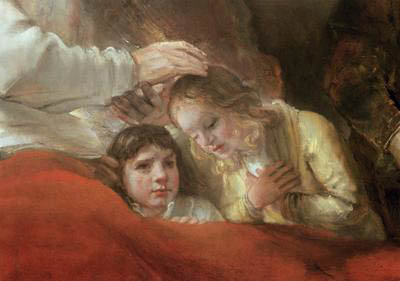
Children receiving the blessing of the father before retiring for bed |
When far from the family, a son or daughter asks this blessing by letters and other means, and such blessings fall like dew on the soul of a child.
For similar reasons, it is also normal for a child to ask the blessing of his grandparents, godparents, uncles and aunts. In Catholic countries, the blessing is not just something for children, but grown men and women are not ashamed to ask the blessing of their parents either privately or in public.
A head of a religious order or congregation also gives his blessing to its members. Also, Catholic priests, our parents in the spiritual order, are invested with the prerogatives of paternity.
Greetings in Church
The Church is the house of God and place of prayer. For this reason, it is not the place for small talk, conversation or laughter. In Church one does not greet his friends or acquaintances. In exceptional cases, acknowledgement of another can be given by a simple inclination of the head, but never with a handshake. Greetings and conversations should be reserved for after one leaves the Church.
When passing by a Church or Chapel that houses the Blessed Sacrament, Catholics should make a sign of respect to the Divine Presence. If a man is wearing a hat, he should remove it, or make a small bow or inclination. If he is not wearing a hat, he should make the Sign of the Cross. Similar signs of respect may be made when passing before holy images or familial altars.
Greetings in the home
We should form the good habit of greeting the persons we live with, a custom that makes life more pleasant and sets a good example for everyone. A simple, “Good morning, my dear,” from husband to wife, sets the tonus for the day.
We should also maintain the habit of rising to greet persons who have just entered the room. It is a time-honored display of respect to be shown to a person older or more important than you, someone you are meeting for the first time, or one traditionally shown special respect: a priest, official, a prominent or distinguished person. It is not normal for the parents or older persons to stand to greet children or youth. Adults should only rise for others as a sign of high consideration. One does not rise for equals or inferiors except on very special occasions.
When a seated adult receives a friend of a young daughter or son, he cordially smiles and says some words of welcome. If the youth approaches the adult to greet him, the latter can extend his hand to be shaken.
Hosts and hostesses should rise and go to greet all arriving guests at social events, but once the party is underway, it is unnecessary to stand every time someone enters a room. Standing and offering your seat to an elderly or infirm person or a fragile lady on a crowded subway or train is both courteous and an act of charity.
Examples from Scriptures
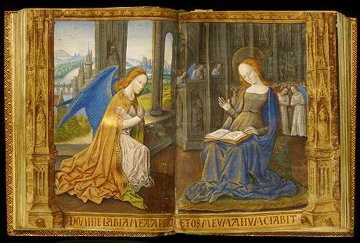
The Angel Gabriel hailed the Virgin Mary with an elevated greeting |
Scriptures is a code of civility. Let us look at just a few examples. What a charming scene when the Angel Gabriel appears in the house of the Virgin, saluting her with the most beautiful of prayers: Hail, Mary. Blessed art thou among women. And the Virgin, taken by surprise by such marvelous words, responds in her simplicity, Behold the handmaid of the Lord…
When Our Lady learned that Elizabeth was with child, she did not delay to make plans to travel from Nazareth to Hebron to congratulate her cousin for this high favor from God. At the meeting, the one who initiated the greeting was the Blessed Virgin, who was younger in age even though she was superior to Elizabeth in dignity: And Mary entered into the house of Zachary and saluted Elizabeth. And it came to pass that when Elizabeth heard the salutation of Mary, the infant leaped in her womb. And Elizabeth was filled with the Holy Ghost. (Lk 1:40-41)
Her words were accompanied by a prodigy of grace: the sanctification of John the Baptist, who leaped with joy in his mother’s womb. It is to commemorate and imitate the humility of Mary in this greeting that the laws of certain religious congregations impose on the superiors the initiative of greeting.

Posted October 18, 2007


Related Topics of Interest
Introduction to the Small Manual of Civility
Chapter 2: Bearing
Chapter 3: How to Sit, Stand, Walk
Chapter 4: Order and the Spirit of Order
Chapter 5: Order in the Professional Life
Chapter 6: The Eyes and the Gaze
Chapter 7: Cleanliness and Good Hygiene
Chapter 8: The Smile, The Laugh, The Grimace
Chapter 9: The Art of Governing the Hands and Feet
Chapter 10: The Voice - Speaking and Conversing
Related Works of Interest
|
|
Formation | Cultural |
Home | Books | CDs
| Search | Contact Us
| Donate
© 2002- Tradition in Action, Inc. All Rights Reserved
|
|
|