Catholic Manual of Civility
Translated and edited by Marian T. Horvat, Ph.D.
The Family Collection
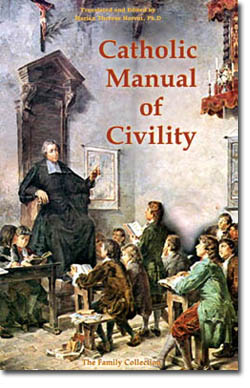
The covers shows St. John Baptist de LaSalle, patron saint of all teachers of youth, teaching in class. Painting by Cesare Mariani, 1888 |
You've been reading the chapters on our website! Now own the book!
The Catholic Manual of Civility is more than a book of rules. It addresses the youth’s formation of character as the foundation of courtesy. It teaches how to be prudent, modest, discreet, and loyal as a basis for being distinguished. It establishes the importance of order, punctuality, and cleanliness as obligations first, before God, and then, as acts of courtesy toward our neighbor. In short, it aims to form the well-bred Catholic.
Yes, it also teaches the needed good rules of etiquette that one should practice both at home and in society.
For a young man or a family who wants to see a restoration of Christian Civilization in customs, manners, and ways of being, the Catholic Manual of Civility will be an invaluable aid.
Format: Paperback, 160 pp.
Publication Date: 2008 (A-21)
Price: $16
Introduction
Table of Contents
Readers Comments

Table of Contents
- A Man’s Bearing Reflects His Education and Virtue
- The Proper Way to Sit, Walk and Stand
- Order and the Spirit of Order
- The Importance of Order in Professional Life
- The Eyes and the Gaze
- Cleanliness and Good Hygiene
- The Smile, the Laugh, the Grimace
- The Art of Governing the Hands and the Feet
- The Voice - Speaking and Conversing
- Discretion in Words and Actions
- Good and Bad Curiosity
- Loyalty
- Punctuality
- Amiability
- The Braggart
- The Value of Distinction
- The Importance of the Greeting
- The Family Milieu
- A Youth’s Relations with His Superiors
- Traveling
- Proper Behavior for Visiting
- Writing Letters
- Table Manners Reveal a Man’s Culture
- Reading and Speech-Making
Introduction
This Catholic Manual of Civility is based on several Brazilian works sent to Tradition in Action by good friends. These manuals were used for the formation of young men in their Catholic high schools until the early 1950s. On a title page of one is a quote from Fenelon: It is virtue that generates true courtesy. And then, these words of Pope Leo XIII: Civility and urbanity in customs strongly predispose minds to attain wisdom and follow the light of truth.
This gives a small taste of the delightful lost fruit that used to be freely given to the youth.
A lost fruit, yes, because the kind of manners set out by such Catholic civility books have fallen into disuse after the cultural revolution of the 1960s, and are rarely found today.
The modern man extols what is spontaneous and easy; the Catholic gentleman of the past measured his every act and word. The modern man treats every man, woman, and child equally; civility moved the Catholic man to honor his neighbor with the respect and esteem owed to him, taking into account the factors of gender, status, rank, and profession.
In short, these were manuals from the best traditional Catholic school of manners, something I had sought for some time.
These texts needed some work before they could be presented to today’s public, so I adapted and updated customs to better fit our times, corrected some historical examples and introduced new ones, and left out some of the complex ceremonials, such as those regarding the use of hats that no longer apply to today’s youth. Finally, I introduced comments that my experience as an educator, writer, and journalist has taught me about the youth of our days. My aim in doing this was to give new form and life to works that were completely
forgotten, that no one wanted to reprint even though they were in the public domain.
I believe you will find this Catholic manual different from the English-written manners books, which focus on practical matters, usually offering a set of rules of etiquette. Manuals like the early Emily Post give detailed instructions on how to eat properly, make introductions, write invitations, and so on. As with most rule books, these readings can be somewhat tedious and monotonous. The contents are more about setting out norms to appear civil, rather than to be civilized. They try to teach a man how to shine for a moment in society rather than forming the entire man and imparting civility as a virtue. For this work, I did not even consider referring to the more recent etiquette books, which have adapted manners to looser, more casual styles and have modified the rules to meet the low morals of our day: e.g. how to word the divorce announcement, step-siblings do’s and don’ts, birth announcements for a single woman ...
This Catholic Manual of Civility is simple and unpretentious in style even while it maintains a ceremonial, respectful attitude. It understands civility as much more than following rules. First and foremost, it insists, civility is the knowledge and practice of the rules of good treatment that men should observe in relations of domestic and social life. No, these are not just “company behavior” rules one learns in order to keep a good reputation and get ahead in life. They are wise counsels which, if followed, will impart a Catholic way of being to a youth, maintained at home and in public.
For example, the youth is warned: The uncivil man will be the object of criticism and sarcasm and his presence considered inopportune. And what is the reason for this rejection by good society? Because his external ways of being and acting reveal the lowness of his soul. Good, pure, and ordered customs reveal a man of good character. Bad, vulgar, and sloppy ways are characteristic of egoists.
True civility is a virtue. It allows us to be master of ourselves because it demands an assiduous vigilance over words, gestures, and actions. The day-to-day victory over our defects and bad tendencies is what forms good character, a principal element of sociability.
*
The first sixteen chapters inform the youth how to order his gaze, smile, laughter, and tone of voice, as well as offer norms regarding prudence, modesty, loyalty, and distinction. In short, they aim to form the well-bred man. Each chapter ends with examples from History, the lives of the Saints, or texts from Scriptures that support the lesson.
The next eight chapters focus on a youth’s relations with others in his family and society. They reveal the profound awareness of social hierarchy and status in Catholic etiquette that is usually ignored or simplified in American etiquette books. Perhaps it is because even our protocol books fear offending our more egalitarian way of being.
To the contrary, this manual instructs the youth that one of the most important points in the matter of civility is the art of treating each one according to the dignity, precedence, and merits that he has acquired. It is the exact opposite of the boast of the revolutionary: “I don’t care who he or she is. I treat everyone the same.”
Note this example of the behavior of a nobleman in France, the Prince of Talleyrand, renowned for his courtesy in dealing with others. At a dinner in his home with members of noble society, he served the beef he was slicing at the table. He offered portions of this main course to each of his guests with different nuances of address and tone:
To the guest of honor, the brother of the King, he said, “Monseigneur, would you do me the great honor of accepting a slice of beef?”
To the second in stature, he said: “Monsieur Duke, could I have the great joy of offering you this slice of beef?” 10 Catholic Manual of Civility
To the third, he said, “Monsieur Marquis, would you give me the pleasure of accepting this slice of beef?”
To the fourth, “My dear Count, permit me, please?”
To the fifth, “Baron, may I serve you beef?”
To the sixth, “Chevalier, would you like some?"
To the seventh, “And what about you, Montrond?”
Finally, to the eight: “Durand, beef?”
As one sees, the addresses and the offers of servings of the meat were graduated according to the social levels of the guests. Stories like this raise the admiration of those with the Catholic spirit and help us understand how things were in a hierarchical society.
Such incidents both fascinate and startle many Catholic parents today who have little or no idea about the refined, disciplined customs of our glorious Catholic past. These relatively young men and women are realizing the importance of civility for maintaining the cordiality and well-being of family life, but they are also acutely aware of the lacunas in their own formation. In fact, many of these good-willed parents are themselves the children of the hippy generation, those “free-spirited” minds that cast aside all the rules and declared war on norms and formalities. Now they are returning to the good path of civilization.
It seems to me that this Catholic Manual of Civility is exactly what they have been looking for. I imagine it will give an assistance to all, but especially to the men who truly desire to see a restoration of Christian Civilization in the customs, manners and ways of being, which have been systematically smashed and destroyed by the Revolution, especially after World War II.
Marian Therese Horvat, Ph.D.
Comments of Readers
"I have so much enjoyed learning about correct deportment, courtesy and Catholic manners. I am really benefiting from the lessons set out in the Catholic Manual of Civility. At 40, it is sad that I am just now learning, and I will do my best to pass this learning on to my four sons. Thank you from the bottom of my heart!" - L.O.,
A few years ago, an American Catholic magazine had an article on manners. They said that gracious manners were considered a sign of sanctifying grace in Catholic Europe. This is the first manual in English that I have seen that takes this point of view." - C.R.
"Thanks for posting the new series on manners geared for young men. We need something like this. There is the mistaken idea here in the United States that manners are more for women than men. Clearly not! The Catholic Manual of Civility is great! I am eagerly awaiting its publication! - T.S.
Dr. Horvat's article from the Catholic Manual of Civility subject really hit the nail on the head about the disgusting manners being tolerated by parents and teachers these days. Such a manual should be included in a school's curriculum. - S.M.
I love the articles from the Catholic Manual of Civility. It is nice to know there is at least someone else who sees the decline in dress (especially the now prevalent unisex dressing), manners, posture, etiquette, language and lack of class and grace in our society. - D.B.
Chapters on Order in the Civility Manual Hit the Mark
|