Often, we have been told that we should abandon the Church as a monarchy and adopt a Church as a communio. Other times we are advised to be open to more 'collegiality' or 'synodality' in the Church. The unclear terms can multiply: the Church should be understood as 'mystery' or a 'sacrament of salvation,' the authority should be a diakonia, and so on.
Too many unclear terms to 'define' an ideal that we should reach!
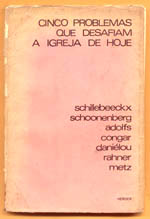
In a collaboration to the book Five Problems that Challenge Today's Church, Fr. Edward Schillebeeckx, although a progressivist, has the merit of being very clear about what these terms mean. They are just covering up the agenda of transforming the Catholic Church into a democracy.
Fr. Schillebeeckx was one of the famous theologians of the avant-garde of the Council. He was a perito of Vatican II as representative of the Dutch Episcopate.
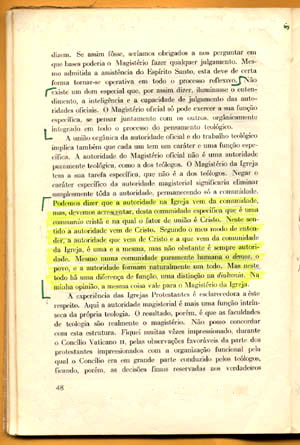
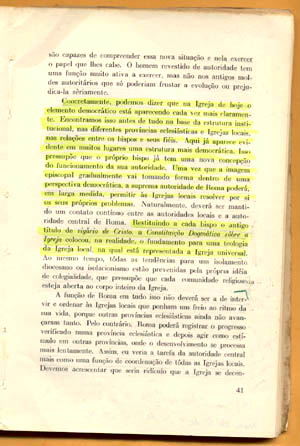
Top right is a facsimile of the book cover; at right, a photocopy of the Portuguese text. Below, we present our translation.
"We can say that authority in the Church comes from the community but, we must add, from this specific communion which is a Christian communio whose factor of union is Christ. In this sense, the authority comes from Christ. As I understand it, the authority that comes from Christ and the authority that comes from the community are one and the same; notwithstanding it is always authority. Even in a purely human community, the demos [the people] and the authority form a whole. But in this whole there is a difference of function, a distinction in diakonia [service]. In my opinion, the same thing applies to the Magisterium of the Church" (E. Schillebeeckx, 'O funcionamento da autoridade na Igreja,' in Cinco problemas que desafiam a Igreja de hoje, Sao Paulo: Herder, 1970, p. 48).
Some pages before, Schillebeeckx shows how this democratic mentality is being adopted by a significant portion of the Church structure:
"In practice, we can say that the democratic element is appearing ever more clearly in today's Church. We find this, above all, in the foundation of the institutional structure, in different ecclesiastic provinces and local churches, and in the relations between the Bishops and the faithful. In many places a more democratic structure is already apparent. This presupposes that the Bishop himself already has a new concept of how his authority functions. Once the episcopal image gradually takes its form within a democratic perspective, the supreme authority in Rome will be able to permit the local churches, to a large extent, to resolve their own problems themselves .... In restoring to each Bishop the former title of vicar of Christ, the dogmatic constitution of the Church (Lumen gentium) in fact laid the foundation for a theology of the local church, wherein the universal Church is represented" (ibid., p. 41).
|
|

Posted on July 7, 2005
|