|
Ecumenism
Curiosities from the “Orthodox” Arena
Atila Sinke Guimarães
On November 10, 2000, the CWN News Agency released a curious document launched by the Russian schismatic church. The 5,000-word statement is entitled Basic Principles of the Attitude of the Russian Orthodox Church toward Other Christian Confessions. The document is worthy of attention for several reasons.
First, it was written in the wake of the declaration Dominus Jesus, and, point by point, it imitates the Vatican declaration, even while it tries to be more radical. The document, which no one knew about until recently, is dated August 14 and affirms that it was approved by the Bishops’ Jubilee Council of the Russian church.
How can it be explained that a topic so similar to that of Cardinal Ratzinger’s document was approved 21 days before Dominus Jesus was issued? This point is not difficult to resolve. Actually, the declaration Dominus Jesus, which came to light on September 5, is predated June 16. The Russians could have done something similar.
Second, it is very curious that the Russians, who are followers of Cerularius – in the 11th century he led the Eastern Schism, a movement that until now has self-proclaimed itself the “orthodox Church” – affirmed in a certain part of their new document that their religious institution is “the One, Holy, Catholic and Apostolic Church.” Really, this is extremely unusual. The confusion that already exists in the Catholic terminology with the progressivist innovations was not enough. Now we have another source of hermeneutical pollution – the schismatics begin to call themselves “catholics.”
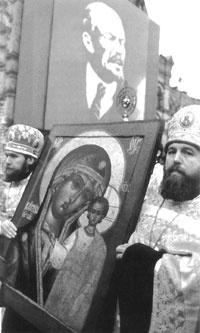
An "orthodox" procession under the Icon of Lenin |
A Catholic, according to the classic definition of St. Robert Bellarmine, adopted by the Magisterium, is one who professes the Catholic Faith, who submits to legitimate Pastors, principally the Roman Pontiff, and shares in common the seven Catholic Sacraments. The followers of Cerularius did not fulfill these conditions, and thus are not Catholics, but schismatics. Here I would like to register my initial rejection of and protest against this aforementioned schismatic document.
Third, another very curious point is the pretension expressed at the beginning of the statement: “The Orthodox Church is the true Church of Christ established by Our Lord and Savior himself.” I recall some facts that speak in the opposite sense of this affirmation. For a long time prior to the Schism (1054), various precursors of the movement, among them Photius (886), defended the heresy according to which the Third Person of the Holy Trinity would not proceed from the First and the Second. Cerularius and other Schismatic Greeks also adhered to this error. Therefore, in the 11th century when the Catholic Church declared this movement schismatic, she was exercising mercy, because the normal procedure would have been to declare it heretical. Until today, the Greek and Russian schismatics defend the same error. In addition to denying this dogma, there are at least three others that are not accepted by the Greek and Russian schismatics: they are the dogmas of the Immaculate Conception, the Papal Primacy and Papal Infallibility. Therefore, in reality, for quite some time the self-proclaimed “Orthodox church” has ceased to be orthodox and has been heretical. How can this religious association pretend to be the true Church of Christ? While the words still have significance, this is an impossible affirmation.
Fourth, in my opinion the arrogance of the document reaches its maximum when it states: “The Orthodox Church, through the mouths of the holy fathers, affirms that salvation can be attained only in the Church of Christ.” Now then, as the Russian schismatic confession consider itself the true Church of Christ, the conclusion is clear. We would have the institution of the Russian schismatic church as the necessary channel for the salvation of the human race, and, an indispensable consequence, we would have the patriarch Alexis II and her predecessors as the connecting link for the distribution of graces to achieve this salvation.
However, according to their most fundamental principles, the various “Orthodox Churches” are Caesar-papists – that is, each one of them is subordinate to the orders of the temporal power of the countries where it exists. This is equivalent to saying that the Russian schismatic church was obedient to and served the Communist regime during the whole time it was in power. I present some proofs taken at random from a rich archive of so many other similar incidents:
* March of 1987: The Communist Kremlin “proposed” the beatification of H. Kostelnyk to the Russian patriarch. Kostelnyk, who was a Catholic priest, played a key role in the “incorporation” of the Ukrainian Catholic Church into the Russian schismatic church in 1945 —an operation forced by Stalin, at the cost of great betrayals. His mission finished, Kostelnyk was assassinated by a secret agent. The crime, however, was attributed by the patriarch Alexis to a “messenger of the Roman Pope.” And according to the same Alexis, the traitor raised to sainthood was a “inexhaustible testifier to the lies and evil of papism” (Catacombes, Paris, March/April 1987, pp. 9f.).
* September of 1991: In an interview in 30 Dias, Alexis II was asked about his collaboration with the Communist government, and made the following confession: “A church that has millions of faithful cannot go into the catacombs. The hierarchy of the church has taken on the sin in their souls: the sin of silence and of lying for the good of the people in order that they not be completely removed from real life. In the government of the diocese and as head of the negotiations as patriarchate of Moscow, I also had to cede one point in order to defend another. I ask pardon of God. I ask pardon, understanding and prayers of all those who I harmed with the concessions, the silence, the forced passivity or the expressions of loyalty that the hierarchy might have manifested during that period” (30 Dias, Rome/ São Paulo, ed. port., August/September 1991, p. 23).
* February 19, 1992: “Revelations of the KBG archives show that the majority of the present day members of the Holy Synod [of the Russian schismatic church] …. were informants for the Communist secret police. Heading the list is the patriarch Alexis, the supreme religious authority of the country” (Veja, São Paulo, February 19, 1992).
* March of 1992: The Russian priest-delegate Gleb Jakunin threatened to publish dossiers “that prove the collaboration given by high members of the Orthodox hierarchy to the Soviet secret police. The press recently divulged the code names of some bishops who were agents in the KGB division of religious affairs. They would include the metropolites Filarete of Kiev and Pitirim. There is also proof and documents against the patriarch Alexis II. …. The newspaper Glasnost, headed by the dissident Serguei Gregorianc, published reports [in 1988] prepared by the then-metropolite Alexis of Leningrad for the Soviet authorities. In July of 1991, Alexis asked pardon for his weaknesses of the past in an interview in the magazine Izvestia: .... ‘I ask pardon .... of all those who suffered because of these concessions, this silence, this forced passivity or these statements of loyalty’” (30 Dias, ed. port., March 1992, p. 32; idem, April 1992, pp. 8-11).
* March of 1992: Speaking about the Russian schismatic church, the schismatic patriarch of Constantinople said: “All collaborated more or less with the [Communist] regime by necessity. Therefore it is not just for one Christian church to accuse another Christian church for having collaborated with the communists, as if it were the only one to so, in order to discredit it in the eyes of the faithful” (30 Dias, ed. port., March 1992, p. 36).
These facts clearly show that the concept of “sanctity” for the Russian schismatics is quite elastic… By adopting this concept, someone who had notably assisted the Communist regime would be a candidate for sanctity, as with the case of Fr. Kostelnyk exposed above. To accept this affirmation made in the recently released document, the action of the Russian schismatic church during the time when it collaborated (and still collaborates) servilely with Communism would be a manifestation of “sanctity.” How can one not see the absurdity of such a supposition? Is it difficult to understand the audacity of the schismatic document when it sustains that salvation can only be obtained within the confines of the “orthodox Church”?
If such affirmation were made only in the schismatic ambit, it would not be the object of much concern for Catholics. The many schismatic churches are split internally into innumerable factions that differ in points of doctrine, law, liturgy, primacy, discipline, etc. In addition to this, as I noted above, they are not independent organizations, but are subordinate to the dominant civil governments. Thus, in almost everything, they are second class organisms, mummified, ready to die, without the necessary convictions to persuade new adepts, and without the strength to attract. This group of churches in themselves do not present a danger for the Catholic Church. If the Holy Church would resolve to make a serious apostolate in Russia and in countries that were beyond the “iron curtain,” if she would abandon the ecumenism of Vatican II and the policies of the recent Popes, today the “Russian orthodox church” would most probably have disappeared or would be reduced to practically nothing.
The “strength” of the Schism lies principally in the regard given it by Catholic progressivism and the conciliar Popes. They close their eyes to the reality and pretend to believe in the myth that these “orthodox churches” would be serious and powerful institutions.
To give only one example, I will mention Cardinal Yves Congar, O.P. – one of the key thinkers of Vatican II – who presented the schismatic system of distribution of power as the ideal for the future of the Papacy and the Catholic Church. That is to say, in thesis, in the schismatic church structure, there is equality among all the patriarchs of each of the independent entities. One of them, the patriarch of Constantinople, receives a primacy of honor and is called the first among equals – primum inter pares. Analogously, according to the progressivist circles, in an ecumenical Papacy, the Roman Pontiff should not appear as a monarch, but as the primum inter pares of the Catholic Bishops, and also of the other heads of the false churches.
To speak even more clearly, conciliar progressivism needs to have the schismatic churches as partners in their ecumenism; otherwise, practically speaking the schismatics would not be taken into account. Perhaps these considerations can help the reader to understand the reason for the arrogance of the schismatics.

|

Related Topic of Interest
Rabbi Sherwin Said ...
Ecumenism | Hot Topics | Home | Books | CDs | Search | Contact Us | Donate
© 2002-
Tradition in Action, Inc. All Rights Reserved
|
|
|