|
Ecumenism
The October Revolution
Atila Sinke Guimarães
Without a doubt the month of October (1999), which just ended, will be remembered in the History of the Church. During this month two especially important events took place: the panreligious meeting in Rome (Oct. 24-28) and the signing of the Catholic-Protestant accord on the doctrine of justification in Augsburg (Oct. 31). In my opinion, we are facing a true revolution. I hope to analyze some aspects of this revolution now and others in the next article. Today, I will address the justification accord.
Even though I am writing on the evening of November 1st and the accord was only signed yesterday, I already have at hand news that arrived from five different reliable sources. Four came from friends by electronic mail, and one is from an article I had saved some days ago. The rapidity with which I am able to make this report is due to the solicitude of my friends, to whom I owe here my thanks. Yesterday and today I visited the sites of the Vatican Information Service and the Vatican News Press Office and there was nothing on the matter, which is understandable since normally it takes several days for reports of events like this to be posted on the Web. Let me, then, go on to synthesize and comment upon this news (1).
My commentaries are open to modifications should there rise a difference between the information I received and the official versions of the Holy See.
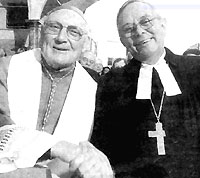
Cardinal Cassidy and Lutheran bishop Krause, after the signing of the Augsburg Accord. |
I will rapidly describe the ceremony. The date for the signing, October 31, was chosen with the intent to pay homage to Martin Luther. On the 31st of October in 1517 he fixed his 95 theses on the door of the Wittenberg Church, thus beginning the Protestant revolt. This first homage undoubtedly signifies that the present day direction of the Catholic Church considers the act of Luther a praiseworthy gesture. It is a symbolic way of saying that Luther had reason to protest against Rome. And it is an indirect way of saying that Rome was wrong in condemning him as a heretic.
The city chosen was Augsburg. In this very city in 1530 Luther declared that his new religion was founded. Thus, the celebration of the act in Augsburg has as its presupposition the “legitimacy” of the Lutheran sect. This does not seem far from accepting the errors taught by the heresiarch.
The first meeting on October 31 took place in the Catholic Cathedral. There, prayers of repentance were said. Once again, an indirect statement of the culpability of the Catholics. It is significant to observe that there is no report in the news of any acknowledgment of blame on the part of the Protestants.
After this, a procession began from the Catholic Cathedral to the Lutheran Church of Santa Ana, where the most important act took place. Again, the act of greater relevance was conferred to the Protestants. Inside the temple were 700 invited guests and 2,000 participants. Those who could not fit in the building participated in the act on a large screen in the City Hall. A Protestant service consisting of prayers and songs began. Assisting were various Cardinals. During the religious service, Protestant bishop Christian Krause, president of the Lutheran World Federation, emphasized the importance of the event. A common prayer followed in which Catholic and Protestants renewed their baptismal vows.
Here, a small interruption is necessary. The validity of the Protestant Episcopal orders was an object of a serious controversy. Leo XIII solemnly declared that the ordinations of the Anglican confession were invalid, and therefore, the sacraments ministered there are without value. If this is true with regard to the Anglicans, something similar would apply to the other Protestant sects who accept bishops. It is absolutely certain that the declaration of Leo XIII is rigorously applied to the Presbyterian and Anabaptist sects, since they, by not admitting bishops, are “ipso facto” incapable of having valid episcopal ordinations. Thus the baptism that exists among the Episcopalians, of which the Lutherans are a branch, is a motive of very serious doubt. This is why, up until Vatican II, when the Catholic Church received a converted Lutheran, a new conditional Baptism was administered. Hence, there is an element of uncertainty in the Protestant baptism.
Therefore, the common renewal of the vows of Baptism made by Catholics and followers of Luther in Augsburg ignores what was described above and takes as a consummated fact the “validity” of the Protestant baptism. This is equivalent to stating that the prior tradition of the Holy Church has no effect. This act carries a series of grave consequences:
- it supposes a true apostolic succession among the Lutheran bishops; it supposes the validity of their sacraments;
- it leads one to accept as valid the “sacraments” of the more radical Protestant sects.
Each of these consequences would be sufficient to declare a person or a movement heretical or suspect of heresy, were the old Code of Canon Law still in place. Incidentally, according to the Code, the simple participation in the same religious ceremony with heretics merited a very rigorous excommunication, an automatic excommunication, without need of any declaration by the authority.
Representing the direction of the Catholic Church was Cardinal Edward Cassidy, president of the Pontifical Council for Promoting Christian Unity. In his talk, he stated, “Our task is not only to continue with the building, but, unfortunately, we also have the duty of seeking to repair the damage that has been done to that building by the storms, conflicts and, at times, man-made earthquakes.” The edifice to which the Cardinal was referring is the Church founded on Christ. According to the words of Cassidy, the Catholic Church and Protestant Pseudo-Reform would be constructing together only one building. It is worth noting that in the metaphor employed by the Cardinal, the fundamental differences between the two religions can be considered as mere meteorological accidents that can cause danger, but not affect the unity of the building. It is, without doubt, a new conception of the Church founded by Our Lord.
After this, the secretary of the Vatican’s Pontifical Council for Promoting Christian Unity, Bishop Walter Kasper, and the general secretary of the Lutheran World Federation, pastor Ishmael Noko, signed the joint declaration and embraced each other. The news reports state that the greater part of those present followed their example, with everyone embracing everyone.
The document on justification has, according to the same sources, the following key-phrase in paragraph 15:
“Together we confess that we are accepted by God and we receive the Holy Spirit, who renews our hearts, empowers us, and calls us to do good works, not on the basis of our merits but only through grace and faith in the salvific work of Christ.”
Thus, the multi-secular discussion between Catholics and Protestants hopes to be resolved by a magic formula: the introduction of the concept of grace, together with faith, as conditions necessary for salvation.
The classic position of Catholics is that faith is necessary for salvation, but in order to merit salvation, faith must be accompanied by good works that reflect the collaboration of the human will. The Protestants deny the contribution of free will for salvation. For them, only faith is necessary for salvation. The document of Augsburg introduces a new notion: grace. Now, faith along with grace would be sufficient for salvation. The value of good works is decidedly denied:
“We receive the Holy Spirit, who renews our hearts, empowers us, and calls us to do good works, not on the basis of our merits but only through grace and faith in the salvific work of Christ.”
According to Protestant bishop George Anderson, head of the Evangelical Lutheran Church of America, the person who introduced the concept of grace in order to save the accord - which was at one point on the brink of collapse - was Cardinal Joseph Ratzinger. “Without him we might not have an agreement,” said Anderson. Protestant theologian Joachim Track also enumerated the three fundamental concessions made by Ratzinger that permitted the document of Augsburg:
“First, he agreed that the goal of the ecumenical process is unity in diversity, not structural reintegration. This was important to many Lutherans in Germany, who worried that the final aim of all this was coming back to Rome. Second, Ratzinger fully acknowledged the authority of the Lutheran World Federation to reach agreement with the Vatican. Finally, Ratzinger agreed that while Christians are obliged to do good works, justification and final judgement remain God’s gracious acts.”
The introduction of the concept of grace, apparently an act of genius and a magic formula, could give the impression that the Protestants are being obliging since they would now admit that not only faith saves, but also grace saves. However, this impression dissolves under careful analysis. In effect, what is at the root of the concept of “Faith alone saves” is that man has no merit to be saved except to believe - nothing more. Any other action that he makes does not merit him salvation. The “grace” of the document of Augsburg does not alter this concept but, on the contrary, reaffirms it. It states that grace does not depend on human correspondence: “Not on the basis of our merits but only through grace and faith.”
However, in everything that the Holy Church teaches, for man to merit salvation he must practice the virtues in a heroic way. If his actions are without value, he is condemned. The “grace” of Cardinal Ratzinger does not depend on any human correspondence, which seems to be a concept foreign to Catholic doctrine and not much different from quietism.
In fact, the following quietist propositions were condemned by Pope Innocent XI in the Constitution Coelestis Pastor (November 20,1687):
“ No. 2. To wish to operate actively is to offend God, who wishes to be himself the whole agent; and therefore it is necessary to abandon oneself wholly in God.
No. 4. Natural activity is the enemy and impedes the operations of God and true perfection because God wishes to operate in us without us ….
No. 40. One can arrive at sanctity without exterior work.”
It is difficult not to find similarities between this new concept of grace and the quietist doctrine of Michael de Molinos.
Therefore, in order to give Catholics the impression that the Protestants ceded something in order to sign the ecumenical accord, this notion of grace was prepared, but in reality it doesn’t seem to change anything in the Protestant doctrine. Moreover, the present day direction of the Catholic Church draws closer to other errors analogous to Protestantism, such as quietism.
Even beyond the dangers pointed out here, the direction of the Catholic Church seems to have the firm resolve of going forward with the union with the Protestants. And of destroying the Catholic dogmatic edifice. In my view, on this October 31, an important step was taken to define the tendencies of the current that directs the Vatican. The Augsburg accord, in itself, seems to be a revolution that opens a new phase of the broader Conciliar Revolution. We are, as everything indicates, in the face of an act that seems to defy the promise of Our Lord Jesus Christ that the gates of Hell would not prevail against the Church. I am certain that we will see great things in the days ahead.
1. The news reports to which I refer: “Ratzinger credited with saving Lutheran pact,” by John Allen in The National Catholic Reporter, October 14, 1999; “Roman Catholic, Lutheran churches sign agreement to end,” Associated Press on line, October 31, 1999; “Pope expresses satisfaction over Catholic-Lutheran agreement,” Zenit, October 31, 1999; “Decisive step toward unity of Catholics and Lutherans,” Zenit, October 31, 1999; “Churches end salvation dispute,” by Katharine Schmidt in Associated Press on line, October 31, 1999.

|

Related Article of Interest
Non Possumus
Ecumenism | Hot Topics | Home | Books | CDs | Search | Contact Us | Donate
© 2002-
Tradition in Action, Inc. All Rights Reserved
|
|
|