|
Formation of Children
Prostrations in Catholic Eastern Rites
Dr. Pamela Dettman
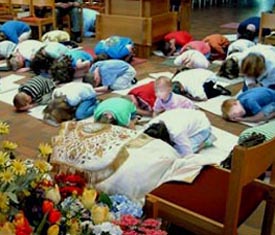
The article “Muslim-Style Adoration for Catholic Children” by Margaret Galitzin triggered a very lively discussion in several circles. Many traditionalist and conservative Catholics of good sense are backing the position opposing the novel program of Children of Hope. Others, with a more liberal tendency are trying to justify the prostration position being imposed on our children as merely an application of a Catholic Eastern Rite practice. I would like to offer my experience as a member of an Eastern Catholic parish for several years in order to show how the argument of those liberal Catholics is faulty. The prostrations in those rites are completely different from those Muslim-inspired ones of the Children of Hope.
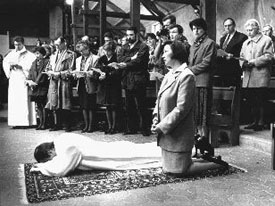
In Catholic Eastern rites, above, prostrations are different from those of the Children of Hope, below
 |
I attended my first Divine Liturgy in a Ruthenian Catholic parish during Lent. One of the first strange customs I noticed was that of prostrations, which is the normal practice during what is called the "Great Fast." This is the time of the liturgical year for penance for all Catholics, and the Byzantines show this with an "extra" penitential posture for the laity. Although foreign to me at the time, it seemed entirely appropriate and meaningful. The prostrations are an accompaniment to the Prayer of St. Ephraem the Syrian, Doctor of the Holy Catholic Church. An English translation of this beautiful prayer follows:
O Lord and Master of my life, keep me from the spirit of indifference, sloth and discouragement, lust of power and idle chatter [prostration]. Instead, grant to me your servant, the spirit of chastity, humility, patience and love [prostration]. O Lord and King, grant me the grace to be aware of my sins, and not to judge my brother, for You are blessed now and ever and forever. Amen [prostration]
O God, be merciful to me a sinner [make the sign of the cross (+) and bow] O God, cleanse me of my sins and have mercy on me [+ and bow] O Lord, forgive me, for I have sinned without number [+ and bow]* Repeat the entire prayer with a final prostration to close.
To be clear, this posture for Eastern Catholics is a full prostration, with forehead to the floor and legs fully extended. Prostrations of this sort are done during Lent and on the Feast of the Holy Cross. In addition to this, on all days except Sundays and Feast Days, altar boys (or men as is often the case) prostrate during the consecration. Coming from a Novus Ordo upbringing, with all its attendant disrespect during what we are told is God being called down onto the altar, one can imagine the profound impact at seeing such an act of humility before God take place during the Holy Sacrifice of the Mass. This humility is perfectly instilled in all present, and belief in the True Presence remains intact for Eastern Catholics. Sacrilegious "touching" of the Body and Blood of Our Divine Lord is unthinkable in such a respectful setting.
As moving as such an act of reverence is, however, and though priestly candidates use Catholic prostrations during their Ordination ceremony, they are not part of Roman Catholic Tradition in general. The Latin Rite equally preserves the necessary attitude of humility before God, with its own postures and devotions. It was with Vatican II’s Novus Ordo, that such reverence was so quickly abandoned, and not from the lack of Eastern Catholic postures.
In my opinion, it is not correct or appropriate to introduce prostrations into the Latin Rite any more than it would be appropriate to make Eastern Catholics use Gregorian chant or replace their sacred liturgical languages with Latin. What is unique in each of the Apostolic Rites has been preserved by Sacred Tradition and handed down intact for a reason. Who would dare to alter what God has deemed worthy to preserve?
Margaret Galitzin’s comments are entirely with merit. The concerns raised are legitimate. Encouraging Catholics to now implement what has become commonly recognized as a Mohammedan posture is a highly suspect position and appears to bolster the ecumenical tendency for Syncretism and Religious Indifferentism.

Posted November 16, 2007

Related Topics of Interest
Muslim-Style Prostrations for the Children of Hope
Charismatics, Devils and Modernists
Lesbian Batwoman Comes ‘Out of the Closet’
The Pope at the Mosque - A Scandal
They Ask for Bread and Receive Stones
Related Works of Interest
|
|
Formation | Cultural | Home | Books | CDs | Search | Contact Us | Donate
© 2002- Tradition in Action, Inc. All Rights Reserved
|
|
|